Home › Milestones › When do babies sit up?
When do babies sit up?
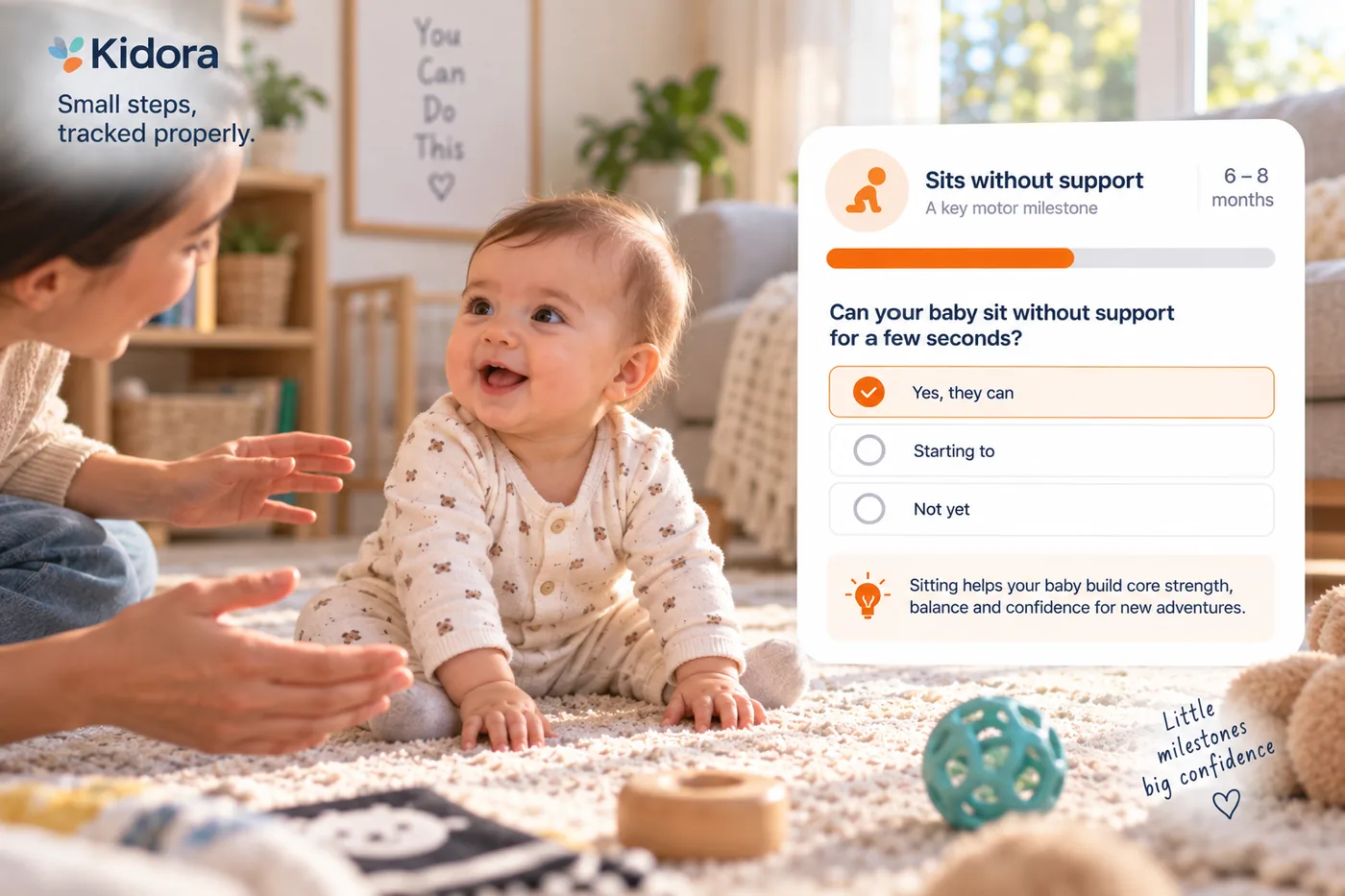
Most babies sit without support between 6 and 8 months. Propped sitting with hands on the floor usually appears around 5 to 6 months, and steady sitting with free hands by 8 to 9 months. Speak to your doctor if your baby is not sitting unsupported by 9 months.
Sitting is the milestone that changes a baby's whole day. Lying down, the world is a ceiling. Sitting up, they can see across a room, reach with both hands and join in at the table.
At what age do babies sit up?
Babies typically sit with support from 4 months, sit propped on their hands around 5 to 6 months, and sit unsupported between 6 and 8 months. By 9 months most can sit steadily with both hands free to play, and can get into sitting on their own.
| Stage | Typical age | What it looks like |
|---|---|---|
| Supported sitting | 3 to 5 months | Sits held on a lap or against cushions, head steady |
| Tripod sitting | 5 to 6 months | Sits leaning forward on both hands, wobbly, topples often |
| Sitting unsupported | 6 to 8 months | Sits alone for a minute or more without hands down |
| Sitting and playing | 7 to 9 months | Both hands free, turns to reach without falling |
| Getting into sitting | 8 to 10 months | Pushes up into sitting from lying, without help |
Getting into sitting is a separate skill from staying there, and it usually arrives one to two months later. A baby who is placed in sitting and holds it well is doing fine even if they cannot yet get there alone.
How can you help your baby learn to sit?
Tummy time builds the back and neck strength sitting needs. Short spells of supported sitting on the floor, propped with your hands or a cushion behind, let a baby practise balance. Floor time matters more than seats or sitting rings.
- Tummy time, several short sessions a day. This is the foundation.
- Sit them between your legs on the floor, facing out, so your body is the support and they do the balancing.
- Cushion the landing. A rug or a folded blanket behind and to the sides makes toppling harmless, which is how they learn to correct.
- Put toys just in front and to the side so they have to shift weight to reach.
- Use seats sparingly. Sitting rings and bouncers hold a baby upright without them doing the work, so they build no balance at all.
Let them topple. A baby who is caught every time never learns the small corrections that keep them upright. Clear the space, sit close, and let the wobble happen.
Check every milestone for your baby's age
Free, about eight minutes, covering all six areas of development.
Start the free checkWhen should you speak to a doctor?
Speak to your doctor if your baby is not sitting with support by 6 months, is not sitting unsupported by 9 months, feels stiff or floppy to handle, cannot hold their head steady, or has lost the ability to sit.
- A skill has gone backwards. Book an appointment.
- No sitting with support by 6 months.
- No sitting unsupported by 9 months.
- Head still unsteady at 6 months.
- Stiff, floppy, or always leaning to one side.
- Uses one arm much more than the other to prop.
Corrected age for premature babies
Count from the due date rather than the birth date until around two years. A baby born two months early who sits at nine months is sitting at seven months corrected, which is on time.
What comes after sitting?
Sitting frees both hands, which is why it often triggers a jump in fine motor skills. Passing an object between hands, banging two things together and the pincer grip all tend to arrive soon afterwards.
Movement usually goes next: crawling or bottom-shuffling, then pulling to stand, then walking. Some babies skip crawling entirely, and that is not a problem.
Questions parents ask
Common questions about sitting up
Can a 4 month old sit up?
With support, often yes. Sitting propped on a lap or against cushions is common at four months. Sitting alone without support is not expected until around six months.
Is it bad to sit a baby up too early?
Propping a baby who has no head control does not help and takes time away from tummy time, which is what actually builds the strength. Supported sitting once head control is steady is fine.
Do sitting rings and seats help?
Not much. They hold a baby upright without them doing the balancing, so no balance is built. Floor time is more useful, and long spells in any seat reduce the practice that matters.
My baby sits but topples over. Is that normal?
Completely. Toppling is how balance is learned. Clear the area, stay close, and let the wobble happen rather than catching every one.
Does sitting late mean walking late?
Not reliably. Some babies sit late and walk on time. What matters more is steady progress across all the movement skills rather than the date of any single one.
Related
Written and reviewed by Ms. Tehreem Talat, Consultant Clinical Psychologist. Last reviewed 9 September 2026. Milestones drawn from the Portage checklist and CDC guidance. See our sources. This page is a guide for parents, not a medical diagnosis.