Home › Milestones › When do babies walk?
When do babies walk?
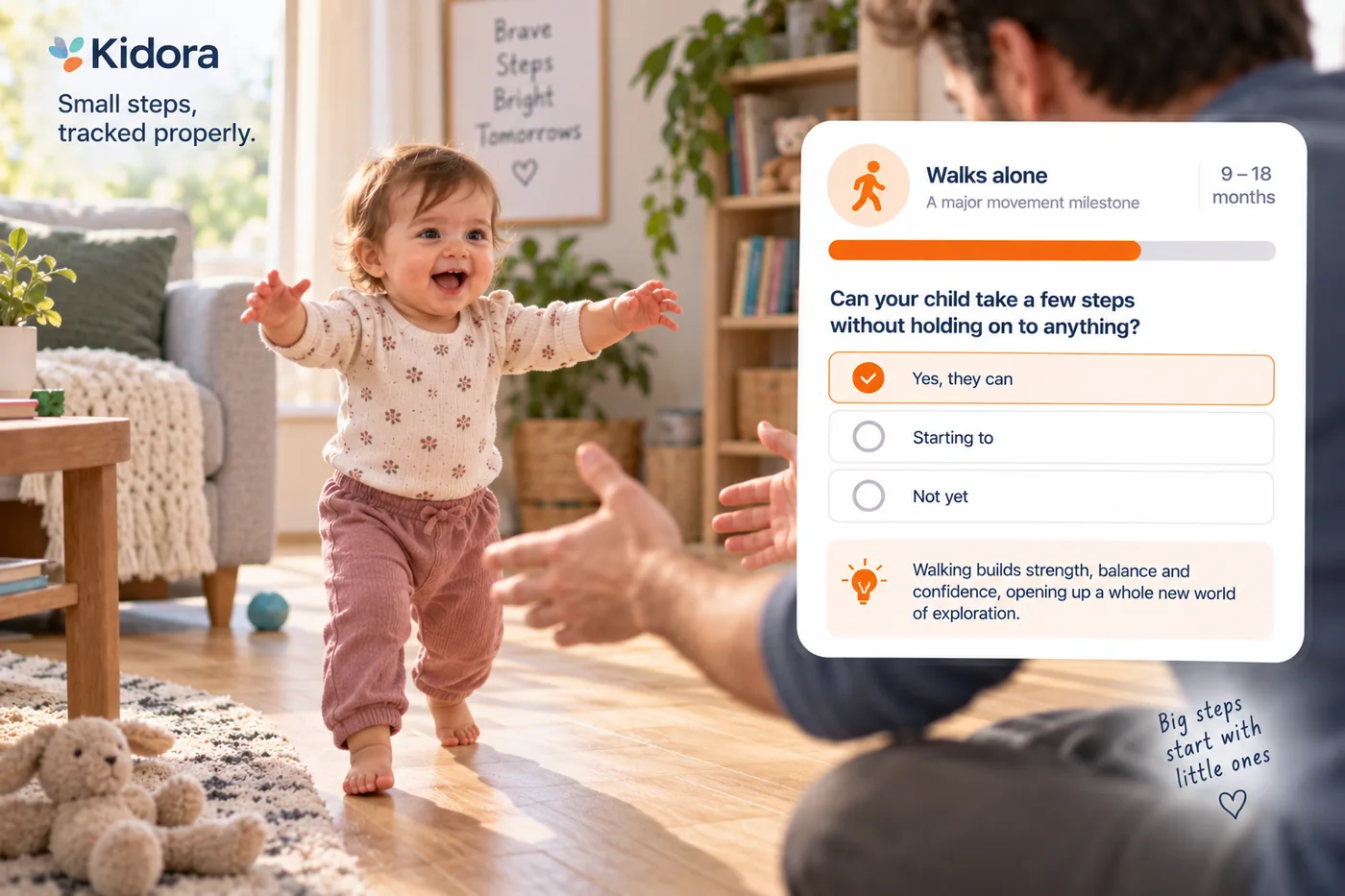
Most babies walk alone between 9 and 18 months. That range is nine months wide and every month in it is normal. A child walking at 16 months is not behind a child who walked at 10. Speak to your doctor if your child is not walking at all by 18 months.
No milestone gets compared more than this one, and none has a wider normal range. That combination is why walking causes more unnecessary worry than anything else in the first two years.
At what age do babies walk?
Babies typically pull to stand around 9 months, cruise along furniture from 9 to 12 months, stand alone around 11 to 13 months, and walk independently between 9 and 18 months. Most take their first steps close to their first birthday.
| Stage | Typical age | What it looks like |
|---|---|---|
| Pulling to stand | 8 to 10 months | Hauls up on furniture, often stuck standing and unsure how to get down |
| Cruising | 9 to 12 months | Steps sideways along the sofa, both hands holding on |
| Standing alone | 11 to 13 months | Lets go and balances for a few seconds |
| First steps | 9 to 18 months | Two or three steps between furniture, arms high for balance |
| Walking steadily | 13 to 18 months | Crosses a room, stops and turns without falling |
Cruising is the reliable signal. A baby who cruises confidently has the strength and balance, and what is missing is only the confidence to let go. That usually resolves on its own.
Why do some babies walk later?
Late walking is usually explained by temperament, body build, prematurity or limited floor time rather than anything medical. Cautious babies watch before committing, and heavier babies often take longer. Most late walkers are entirely typical.
- Temperament. Some babies will not attempt something until they are sure of it. These children often walk late and then barely fall.
- Prematurity. Use corrected age until around two years.
- Bottom-shufflers walk later on average. Shuffling is fast and comfortable, so there is less reason to try standing. This is a recognised normal variation.
- Not enough floor time. Long spells in seats, walkers and slings reduce practice.
- Body build. Heavier or taller babies sometimes take longer to balance.
Barefoot indoors, on any safe surface. Feet send balance information that shoes muffle and socks make slippery. Shoes are for outdoors and for protection, not for learning to walk.
Check every milestone for your baby's age
Free, about eight minutes, covering all six areas of development.
Start the free checkHow can you help your baby learn to walk?
- Floor space, cleared and safe. This is most of it.
- Furniture at cruising height arranged with small gaps, so she has to reach from one to the next.
- Push toys with weight, like a sturdy trolley. A toy that shoots away is worse than none.
- Hold one hand, not two. Two hands does the balancing for her.
- Skip baby walkers. They hold a child upright before balance is ready, reduce floor time, and carry a real injury risk.
When should you speak to a doctor?
Speak to your doctor if your child is not walking at all by 18 months, is not pulling to stand by 12 months, walks only on tiptoes, uses one side of the body much more than the other, or has stopped walking after previously doing it.
- A skill has gone backwards. Book an appointment.
- Not pulling to stand by 12 months.
- Not walking at all by 18 months.
- Constant tiptoe walking that persists past two years.
- One side used much more than the other, or dragging one leg.
- Stiff or floppy to handle, or legs that cross when held upright.
What "he'll get there" misses
Most late walkers are fine, and most of the time that advice turns out to be right. The problem is that it is given to everyone, including the small number of children who need help. An appointment at 18 months that finds nothing has cost you an hour. Waiting until three, if something was there, costs more.
Questions parents ask
Common questions about walking
Is it normal for a baby to walk at 9 months?
Yes. Nine months is the early end of the typical range. Early walking is not a sign of anything beyond that particular child being ready.
My baby is 15 months and not walking. Is that a problem?
Not by itself. The typical range runs to 18 months. If your child pulls to stand and cruises along furniture, the strength is there. Speak to your doctor if there is no walking at all by 18 months.
Do baby walkers help?
No. They hold a child upright before balance is ready, reduce the floor time that builds walking, and carry a genuine injury risk. Floor space works better.
Should my baby wear shoes to learn to walk?
Barefoot is better indoors. Feet feed balance information that shoes block, and socks slip. Shoes are for outdoors and protection.
Does walking late mean a child will be behind?
No. Age of walking within the normal range does not predict later coordination, sport or school performance. It predicts the age of walking, and nothing else.
Related
Written and reviewed by Ms. Tehreem Talat, Consultant Clinical Psychologist. Last reviewed 9 September 2026. Milestones drawn from the Portage checklist and CDC guidance. See our sources. This page is a guide for parents, not a medical diagnosis.