Home › Motor skills
Motor skills in children
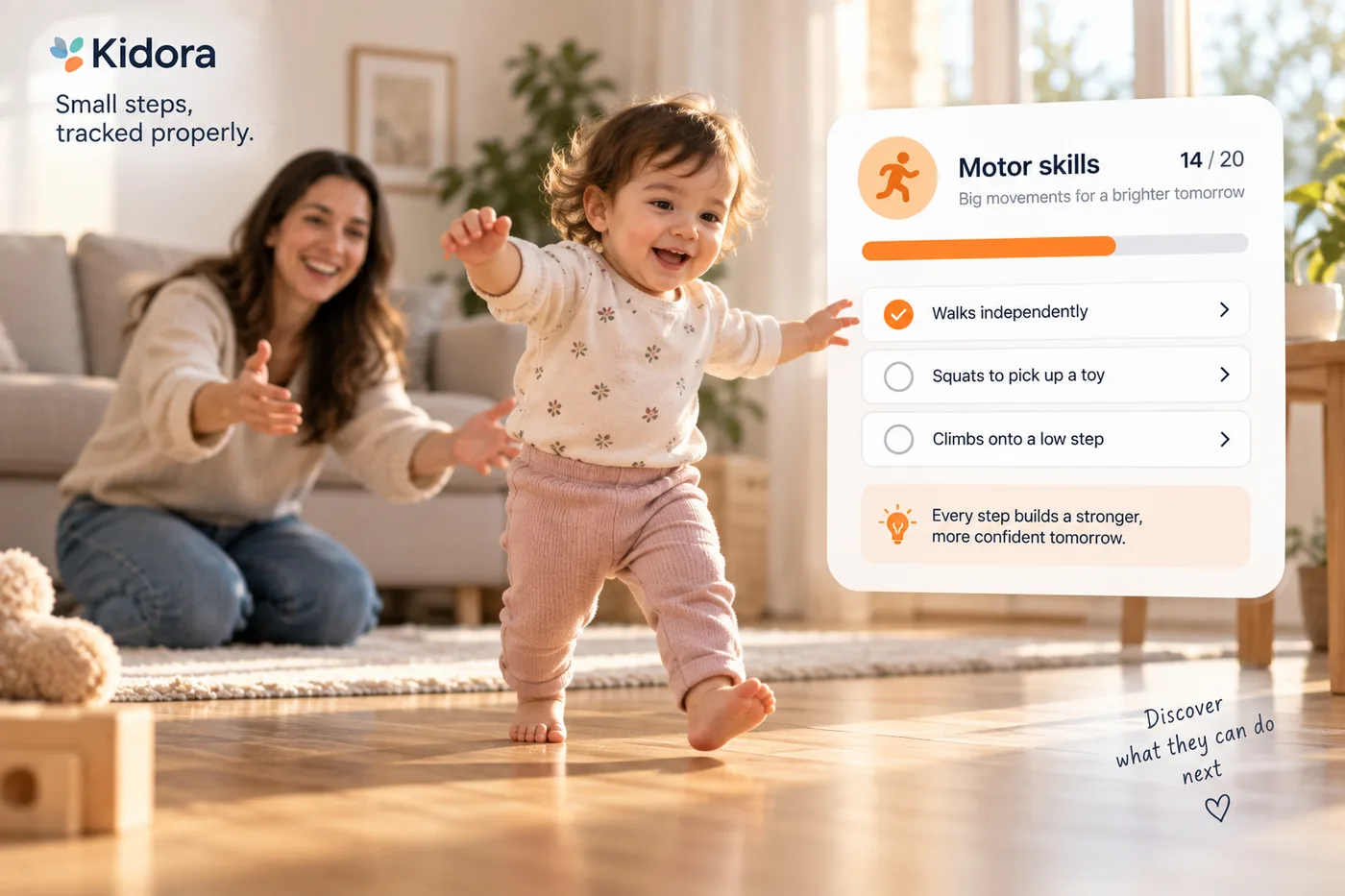
Motor skills are the movement skills a child builds from birth, from lifting the head to running and holding a pencil. They split into gross motor skills, which use the large muscles, and fine motor skills, which use the hands and fingers. This page covers both, age by age.
Movement is the one area of development nobody has to be told to watch. Grandparents ask about walking. Neighbours ask about walking. Nobody ever asks whether your fourteen-month-old can point at a picture when you name it.
That attention has a cost. Because motor skills are so visible, a late walker gets treated as an emergency while a child struggling to hold a spoon goes unnoticed for a year. Both are motor skills. Only one of them gets discussed at family gatherings.
What are motor skills?
Motor skills are the ability to control the body's muscles to produce movement. They develop from the head downward and from the centre of the body outward, which is why a baby holds their head steady before they sit, and sits before they use their fingers precisely.
Two rules govern the whole sequence, and knowing them explains most of what you'll observe.
Development runs head to toe. Head control comes first, then the trunk, then the legs. And it runs centre outward, so shoulder control arrives before elbow control, which arrives before wrist and finger control. That second rule is why a toddler who cannot yet grip a crayon properly isn't behind on hands. She's still building the shoulder.
Kidora's checklist holds 140 motor checkpoints, the largest of the six areas. Motor development gets the most checkpoints because it produces the most observable, gradable steps between birth and six.
What is the difference between fine and gross motor skills?
Gross motor skills use the large muscles for whole-body movement like walking, jumping and climbing. Fine motor skills use the small muscles of the hands and fingers for precise tasks like threading beads, using a spoon and holding a pencil. Both develop in parallel, not in sequence.
| Gross motor | Fine motor | |
|---|---|---|
| Muscles used | Large: legs, arms, trunk | Small: hands, fingers, wrists |
| Typical skills | Rolling, sitting, walking, running, jumping, climbing | Grasping, threading, buttoning, cutting, drawing |
| First appears | Birth, with head control | Around 3 to 4 months, with reaching |
| Noticed by parents | Immediately | Often late, usually at nursery |
| Shows up at school as | PE, playground confidence, sitting still | Handwriting, scissors, doing up a coat |
The distinction matters more than it looks. A child can be well ahead on one and behind on the other, and that combination is common enough that treating "motor skills" as a single score hides it.
Fine motor skills
Hands and fingers. Grasping, threading, drawing, buttoning, and the grip behind handwriting.
Read the full guide →Gross motor skills
Whole-body movement. Sitting, walking, running, jumping, climbing and balance.
Read the full guide →What motor milestones should you expect at each age?
Most babies hold their head steady by 4 months, sit unsupported by 8 months and walk between 9 and 18 months. By 3 years most children pedal a tricycle and copy a circle. By 5 most hop on one foot, use scissors and hold a pencil in a mature grip.
| Age | Gross motor | Fine motor |
|---|---|---|
| 0 to 6 months |
|
|
| 6 to 12 months |
|
|
| 1 to 2 years |
|
|
| 2 to 3 years |
|
|
| 3 to 4 years |
|
|
| 4 to 6 years |
|
|
Judge a skill by how it looks, not just whether it happens. A four-year-old who holds a pencil in a whole-fist grip is drawing, so the box gets ticked, but the grip is two years behind. Quality is where fine motor problems hide.
See where your child stands in eight minutes
Free, no account needed, and it covers all six areas rather than movement alone.
Start the free checkWhat causes delayed motor skills?
Most motor delay comes from ordinary causes: prematurity, limited floor time, illness, or simply not having had a chance to practise. A smaller number relate to muscle tone, coordination difficulties, vision problems, or an underlying neurological condition that needs assessment.
Ranked roughly by how often they turn out to be the answer:
- Prematurity. Use corrected age until around two. A baby born eight weeks early who sits at ten months is sitting at eight months corrected, which is on time.
- Not enough floor time. Babies who spend long stretches in car seats, bouncers and slings get less practice. Tummy time is the single most modifiable factor on this list.
- Temperament. Cautious children walk later. They watch, then commit. This is a personality difference, not a delay.
- Low or high muscle tone. A baby who feels floppy or stiff to handle should be assessed rather than watched.
- Vision problems. Reaching, crawling and catching all depend on seeing properly. A vision check is a cheap thing to rule out early.
- Neurological or genetic conditions. The least common group, and the reason the pattern matters more than any single late skill.
One myth worth killing: skipping crawling does not cause problems. Plenty of children go straight from sitting to cruising to walking and turn out completely typical.
When should you worry about motor development?
Speak to a doctor if your child loses a movement skill they had, is not sitting by 9 months, is not walking by 18 months, uses only one side of the body, or feels unusually stiff or floppy. Persistent tiptoe walking past two years also warrants a check.
- A skill has gone backwards. This outranks everything else on the page.
- Strong hand preference before 18 months. Babies use both hands. A clear favourite this early can mean the other side isn't working as well.
- Not sitting unsupported by 9 months, or not walking by 18 months.
- Stiff or floppy to handle, or legs that scissor and cross when held upright.
- Walking on tiptoes constantly past two. Occasional tiptoe walking in toddlers is normal. Constant is worth a look.
- Your instinct says something is wrong. Parents are usually right.
Who to speak to
Start with your paediatrician. Gross motor concerns usually route to a physiotherapist, fine motor concerns to an occupational therapist. Take a short written list of what your child can and cannot do, with rough dates. It changes the quality of that appointment completely.
How can you help motor skills at home?
Give children floor time, space and objects to manipulate rather than structured exercises. Tummy time from birth, barefoot walking on varied surfaces, climbing, and everyday tasks like pouring and dressing build motor skills faster than any toy marketed for the purpose.
Tummy time from day one
Short sessions, several times a day, on the floor rather than a cushion. Lie down facing her so there's a reason to lift the head. This is the foundation for rolling, sitting and crawling.
Barefoot on different surfaces
Grass, sand, a rug, a cool tiled floor. Feet send balance information that shoes muffle. Indoors, barefoot beats socks, which slip.
Let them pour their own drink
A small jug, half full, over a tray. Pouring builds wrist rotation and grip strength, and it matters to the child in a way that a threading toy never quite does.
Break the crayons in half
A short crayon is too small to hold in a fist, so the fingers have to form a proper grip. This is the cheapest fine motor intervention there is.
Get motor activities matched to your child →
Questions parents ask
Common questions about motor skills
What are the two types of motor skills?
Gross motor skills, which use the large muscles for whole-body movement, and fine motor skills, which use the hands and fingers for precise work. Both develop at the same time rather than one after the other.
At what age should a child walk?
Between 9 and 18 months, and every month in that range is normal. Speak to your doctor if your child is not walking at all by 18 months.
Does skipping crawling cause problems later?
No. Some children bottom-shuffle, some go straight from sitting to walking, and there is no good evidence this causes reading or coordination problems later. The claim is popular and unsupported.
Is walking on tiptoes a problem?
Occasionally, no. Toddlers experiment. Constant tiptoe walking past two years should be checked, because it can point to tight heel cords or a tone difference.
Do walkers help babies learn to walk?
No, and they carry a real injury risk. Baby walkers hold a child upright before their balance is ready and reduce the floor time that actually builds walking. Floor space works better.
How much tummy time does a baby need?
Aim for short sessions spread through the day, building toward about an hour in total by three months. Several short goes beat one long one, because a tired baby stops working.
Related
Written and reviewed by Ms. Tehreem Talat, Consultant Clinical Psychologist. Last reviewed 9 September 2026. Milestones drawn from the Portage checklist and CDC guidance. See our sources. This page is a guide for parents, not a medical diagnosis.