Home › Language development
Language development in children
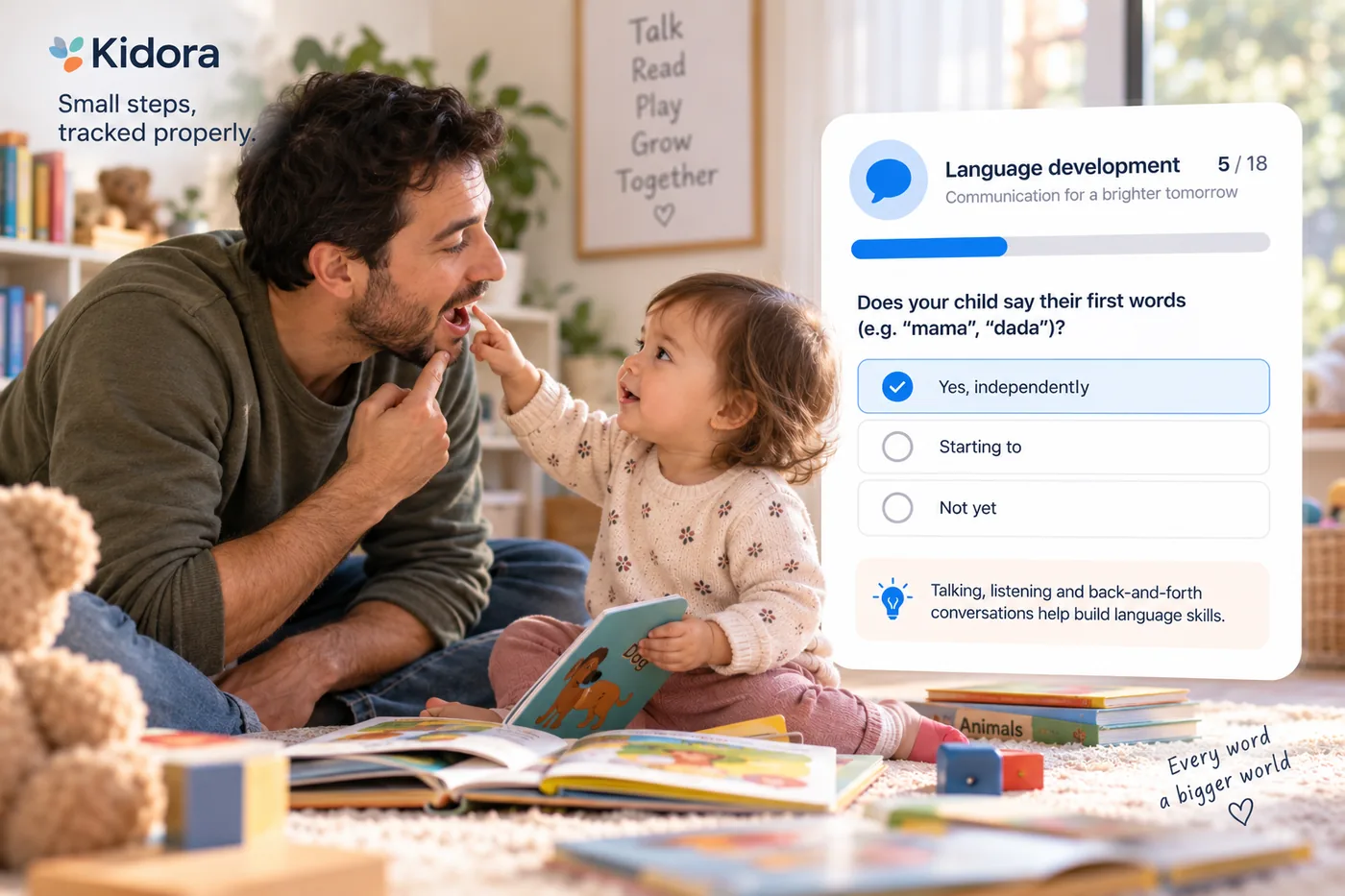
Language development is how a child learns to understand and use words, from first sounds to full conversations. It has two halves: understanding what others say, and producing speech. Understanding always comes first, which is why a child follows instructions months before speaking clearly.
Language is the area parents worry about most and understand least. Everyone knows roughly when a baby should walk. Almost nobody knows how many words a two-year-old should have, so the worry has nothing to attach itself to.
And the advice is contradictory. One relative says give it time. Another says get her tested. Here's what the evidence actually supports.
What is language development?
Language development is the process of learning to communicate through words. It covers receptive language, which is understanding what is said, and expressive language, which is producing words and sentences. Speech, the physical act of making sounds, is a separate skill from language.
Three terms get used interchangeably and shouldn't be:
- Receptive language. Understanding. Following "get your shoes" before being able to say either word.
- Expressive language. Producing words, then joining them, then building sentences.
- Speech. The physical production of sounds. A child can have excellent language and unclear speech, or clear speech and very little language.
Receptive language runs ahead of expressive language throughout early childhood. A fourteen-month-old with three words understands dozens. That gap is normal and it's the reason a quiet toddler who clearly understands everything is in a very different position from a quiet toddler who doesn't respond to their name.
Language also leans hard on the other areas. Words are learned through social interaction, and the concepts underneath them come from cognitive development. A child who cannot name colours may have a language gap or a thinking one, which is why checking language alone tells you less than checking all six.
What are the stages of language development?
Language moves through five broad stages: cooing from around 2 months, babbling from 6 months, first words around 12 months, two-word phrases around 24 months, and sentences from 3 years. Each stage builds on the one before rather than replacing it.
| Stage | Typical age | What it sounds like |
|---|---|---|
| Cooing | 2 to 4 months | Open vowel sounds, ooh and aah, usually in response to a face |
| Babbling | 6 to 10 months | Repeated consonant strings like bababa and dadada |
| First words | 10 to 15 months | One or two real words used with meaning, alongside pointing |
| Word combining | 18 to 24 months | Two words joined, such as more milk or daddy gone |
| Sentences | 2½ to 4 years | Three to five word sentences, questions, and past tense |
Pointing is the stage nobody counts
Before words there's gesture. A twelve-month-old who points at something to show you, rather than to get it, is doing the thing that words are built on: sharing attention with another person on purpose.
That's why a lack of pointing by 15 months carries more weight than a small vocabulary at 18 months. Most parents have never been told this, and it's the single most useful early signal on the page.
What language milestones should you expect at each age?
Most babies babble by 9 months and say a first word by 15 months. By 2 years most have around 50 words and join two together. By 3 most speak in short sentences strangers can understand. By 5 most tell a full story with correct grammar.
| Age | Understanding | Speaking |
|---|---|---|
| 0 to 6 months |
|
|
| 6 to 12 months |
|
|
| 1 to 2 years |
|
|
| 2 to 3 years |
|
|
| 3 to 4 years |
|
|
| 4 to 6 years |
|
|
Kidora's check contains 99 language checkpoints and asks only the ones for your child's age band, so a parent of a one-year-old is never asked about four-year-old grammar.
Count what your child understands, not just what they say. Ask them to fetch something from another room without pointing or gesturing. A child who does it reliably has strong receptive language, and that changes the picture completely even if they barely speak.
Check your child's language free
About eight minutes, and it shows how language compares against the other five areas.
Start the free checkWhat causes a speech delay?
The most common causes of speech delay are hearing loss, including glue ear after repeated ear infections, limited back-and-forth conversation, and developmental language disorder. Less often it relates to autism, a physical difficulty with the mouth, or a broader developmental condition.
- Hearing. The first thing to rule out, always. Glue ear following repeated ear infections is common, easy to miss, and treatable. A child who hears words as muffled cannot learn them.
- Not enough conversation. Language is built through back-and-forth exchanges, not exposure. Screens and background television supply words without turns, and turns are the active ingredient.
- Developmental language disorder. Difficulty with language that isn't explained by hearing, intelligence or another condition. It's more common than most parents realise and responds well to speech therapy.
- Autism. Language delay is one feature, but it appears alongside differences in eye contact, gesture and shared attention rather than on its own.
- Oral-motor difficulties. Trouble coordinating the mouth muscles for speech, which affects clarity more than vocabulary.
Does being bilingual delay speech?
No. This myth causes real harm, because families get told to drop their home language and then lose fluency in the one language the child was learning best.
Bilingual children hit the major milestones on the same schedule. They may have fewer words in each language early on while having the same total across both, and mixing languages in one sentence is a normal sign of competence rather than confusion. Count words across both languages before concluding anything. If there's a genuine delay, it will show in both.
When should you worry about your child's speech?
Speak to a doctor if your child does not respond to their name by 12 months, is not pointing by 15 months, has no words by 18 months, is not joining two words by 2 years, or loses words they previously used. A hearing test is the first step in every case.
- Words have been lost. A child who was saying words and stopped needs to be seen now. This outranks everything else here.
- No response to their name by 12 months, or no reaction to loud sounds.
- No pointing or gesture by 15 months. Gesture predicts speech, so its absence matters more than a small vocabulary.
- No single words by 18 months.
- Not joining two words by 2 years.
- Strangers cannot understand your child at 3 years.
- Your instinct says something is wrong. Parents are usually right.
Who to speak to
Ask for a hearing test first, whatever else is suggested. It is quick, it is not distressing, and it rules out the most common and most treatable cause. From there, referral is to a speech and language therapist. Take a list of every word your child uses, across all the languages they hear.
The phrase to be sceptical of is "he's a boy, he'll catch up". Boys do sit slightly later on average, but the range is the same and the advice delays help for the children who need it most. Waiting has a cost that checking does not.
How can you help your child's language at home?
Build language through back-and-forth exchanges rather than teaching. Narrate what you're doing, wait for a response, expand what your child says by one or two words, and read together daily. Conversation turns matter more than the number of words a child hears.
Wait five seconds
Ask something, then count to five in your head before filling the silence. Most adults wait about a second. Children need far longer to assemble a reply, and the pause is where their turn goes.
Say it back, plus one
She says "dog". You say "big dog" or "dog running". Adding one word to what the child produced is the most evidence-backed language technique there is, and it takes no preparation.
Narrate the ordinary
Talk through cooking, dressing and shopping as you do it. Words attached to something the child is watching stick far better than words from a screen.
Read the same book again
Repetition is how the words move from understood to used. Pause before a familiar line and let him finish it. Ask what he can see rather than reading straight through.
Get language activities matched to your child →
Questions parents ask
Common questions about language development
How many words should a 2 year old say?
Around 50 words by their second birthday, and they should be joining two words together. Count across every language your child hears, not just one.
Is it normal for a 2 year old not to talk?
A two-year-old with no words needs a hearing test and a speech assessment. That is a sensible first step, not a diagnosis, and hearing problems are a common and fixable cause.
Does bilingualism cause speech delay?
No. Bilingual children reach the major milestones on the same schedule. They may have fewer words in each language while having the same total across both, and mixing languages is normal. Keep your home language.
What is the difference between speech and language?
Speech is the physical act of making sounds. Language is understanding and using words to communicate. A child can have clear speech with very little language, or plenty of language with unclear speech.
Do boys talk later than girls?
Boys sit slightly later on average, but the normal range is the same for both. Using it to explain away a real delay is how children miss the window when help works best.
Does screen time affect language development?
Screens supply words without conversational turns, and turns are what build language. Background television also masks the speech a child would otherwise hear. Time spent talking with a person is what counts.
Related
Written and reviewed by Ms. Tehreem Talat, Consultant Clinical Psychologist. Last reviewed 9 September 2026. Milestones drawn from the Portage checklist and CDC guidance. See our sources. This page is a guide for parents, not a medical diagnosis.