Home › Motor skills › Fine motor skills
Fine motor skills in children
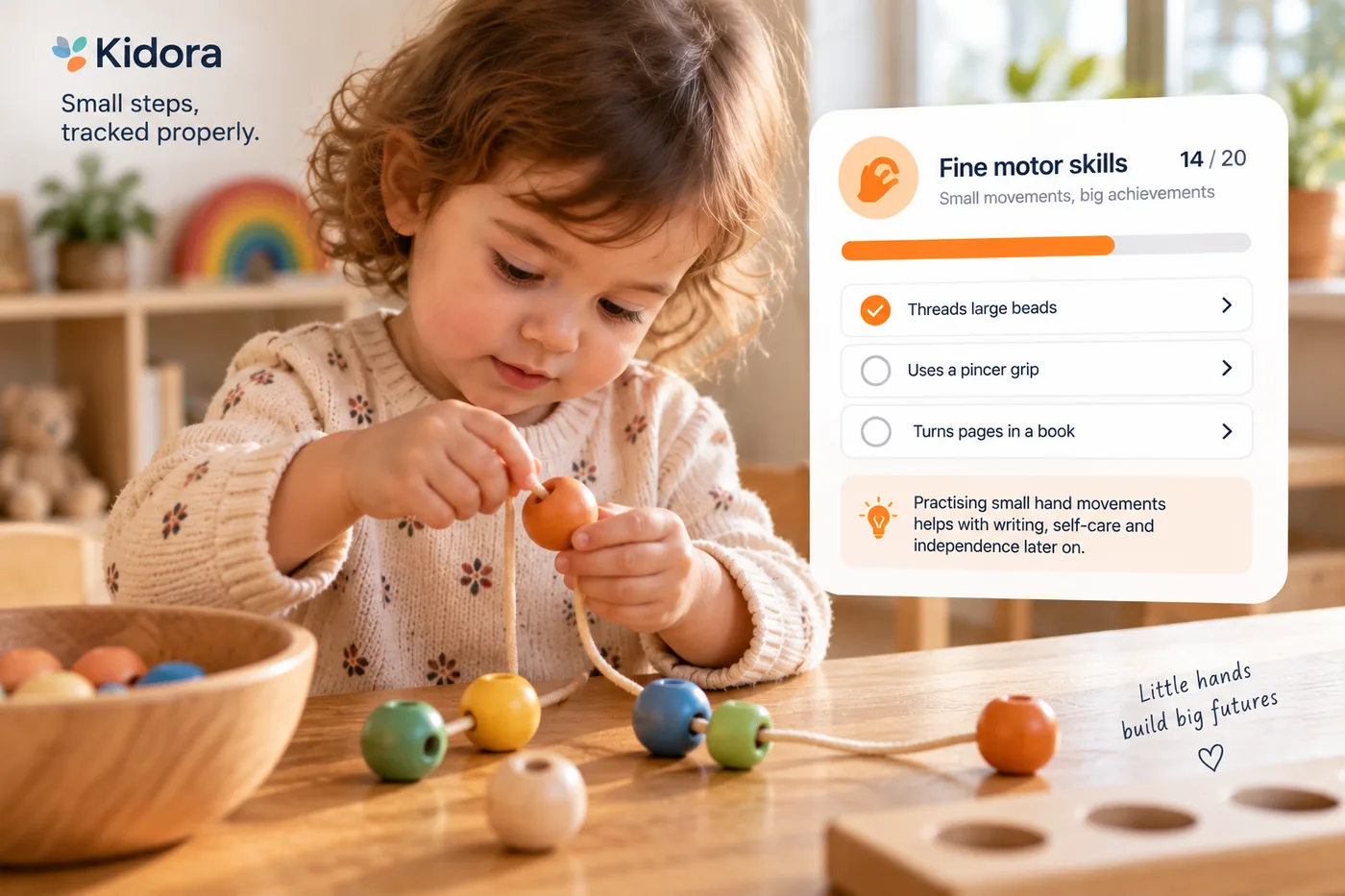
Fine motor skills are the small, precise movements of the hands and fingers, used for holding a spoon, threading beads, doing up buttons and writing. They build gradually from about four months, and they underpin most of what a child is asked to do at school.
Fine motor problems are usually spotted by a nursery teacher, not a parent. That's not negligence. It's that a child at home rarely gets handed scissors and asked to cut along a line, so there's nothing to compare against.
Which makes this the quietest of the six areas. And the one most likely to surface as a problem in reception year, when handwriting suddenly matters.
What are fine motor skills?
Fine motor skills are controlled movements of the small muscles in the hands, fingers and wrists. They combine grip strength, finger isolation, and hand-eye coordination, which is why a task like threading a bead needs several separate abilities working together.
Three things have to come together before a child can thread a bead.
- Grip and strength. Holding the bead firmly enough without crushing it.
- Finger isolation. Using thumb and index finger separately from the rest, which is the pincer grip.
- Hand-eye coordination. Guiding the string to a hole the eyes are tracking.
There's a fourth ingredient people forget: shoulder and trunk stability. Fingers work well only from a stable base. A child who slumps at the table will struggle with a pencil no matter how much handwriting practice you pile on, because the problem is two joints further up. That connection back to gross motor development is the most useful thing on this page.
Why do fine motor skills matter?
Fine motor skills drive independence and school readiness. They determine whether a child can feed themselves, dress, use a toilet unaided, cut with scissors and write legibly. Difficulty here shows up as frustration and avoidance long before it shows up as a diagnosis.
The knock-on effects are the real story. A five-year-old whose hand tires after two lines writes less, so gets less practice, so falls further behind, and eventually decides that writing is something they're bad at. That belief outlasts the physical problem by years.
Fine motor skills also overlap heavily with cognitive development. A toddler who won't complete a puzzle may have worked out exactly where the piece goes and be unable to place it. The score says cognition. The problem is fingers.
What fine motor milestones should you expect at each age?
Most babies grasp an object by 4 months and use a pincer grip by 10 months. By 2 years most stack blocks and scribble. By 3 most copy a circle and snip with scissors. By 5 most hold a pencil in a tripod grip, cut along a line and dress themselves.
| Age | What hands are doing |
|---|---|
| 0 to 6 months |
|
| 6 to 12 months |
|
| 1 to 2 years |
|
| 2 to 3 years |
|
| 3 to 4 years |
|
| 4 to 6 years |
|
Work on a vertical surface. Tape paper to a wall or use an easel, and the wrist automatically extends into the position handwriting needs while the shoulder does the stabilising work. Vertical drawing does more for a pencil grip than tracing worksheets.
Check your child's fine motor skills free
About eight minutes. You'll see how hands compare against the other five areas.
Start the free checkWhat are the signs of a fine motor delay?
Signs of fine motor delay include avoiding drawing and puzzles, a fist grip on a pencil past four years, tiring quickly during hand tasks, dropping small objects often, and needing help with buttons and cutlery well after peers manage alone.
Avoidance is the signal parents miss most. A child who never chooses the drawing table has often worked out that it's hard, and the refusal reads as preference rather than difficulty.
- A whole-fist pencil grip after about four years. The tripod grip should be emerging by then.
- Fatigue. Complaining their hand hurts after a few minutes of drawing.
- Avoiding hand-based play in favour of anything physical.
- Still needs help with buttons, zips and cutlery when peers have moved on.
- Strong hand preference before 18 months, which can mean the other side isn't working as well.
- A skill has gone backwards. Always worth an appointment.
Who to speak to
Fine motor concerns route to an occupational therapist, usually through your paediatrician or the school. Occupational therapy for hand skills is one of the more effective and less invasive interventions in early childhood, and it works better at four than at eight.
How can you improve fine motor skills at home?
Build fine motor skills through resistance and everyday tasks rather than worksheets. Play dough, tearing paper, tongs, pouring, dressing and cooking all strengthen hands, and each has a real purpose the child can see, which is what keeps them going.
Four principles, in order of how much they matter:
- Resistance builds strength. Play dough, squeezing sponges, tearing card. Hands get stronger by pushing against something.
- Small tools force small grips. Broken crayons, short pencils, chalk stubs, tweezers and tongs all make a fist grip physically impossible.
- Real tasks beat exercises. Peeling a satsuma, unwrapping a sweet, buttoning their own coat.
- Stability first. If a child slumps, work on core and shoulder strength before drilling handwriting.
Thread large beads
Start with big beads and a stiff lace, because a floppy string is a much harder task. Dried pasta on a shoelace works exactly as well as a bought set.
Play dough, every day
Rolling, pinching, squashing and pulling apart. Hide small objects inside and let her dig them out. This is the closest thing to a hand gym for a toddler.
Tongs and a bowl
Move pompoms or cereal from one bowl to another with kitchen tongs. The squeeze is the whole point, and children will do it far longer than they'll do a worksheet.
Tear paper into a collage
Tearing needs both hands doing different things at once, which is a genuinely hard skill. Glue the pieces down afterwards so there's a result.
Get fine motor activities matched to your child →
Questions parents ask
Common questions about fine motor skills
What are examples of fine motor skills?
Holding a spoon, picking up a raisin between thumb and finger, threading beads, turning pages, doing up buttons, using scissors and writing. Anything that needs precision from the hands and fingers.
At what age should a child hold a pencil properly?
A mature tripod grip usually appears between four and six years. Before four, a fist or whole-hand grip is normal and expected.
What is a pincer grip and when does it develop?
The pincer grip is picking up a small object between thumb and index finger. It usually appears between 9 and 12 months and is one of the clearest early fine motor milestones.
Can fine motor delay be improved?
Yes. Hand skills respond well to practice, and occupational therapy has a strong track record here. Starting at four produces easier gains than starting at eight, which is the argument for checking rather than waiting.
Are fine motor problems a sign of autism or dyspraxia?
They can occur alongside both, but on their own they are not diagnostic. Plenty of children have fine motor difficulties and nothing else. A professional assessment is the way to answer this, not a checklist.
Do fine motor skills affect handwriting?
Directly. Grip strength, finger control and wrist stability determine how long a child can write and how legible it stays. Handwriting difficulty often traces back to hand strength rather than letter knowledge.
Related
Written and reviewed by Ms. Tehreem Talat, Consultant Clinical Psychologist. Last reviewed 9 September 2026. Milestones drawn from the Portage checklist and CDC guidance. See our sources. This page is a guide for parents, not a medical diagnosis.