Home › Motor skills › Gross motor skills
Gross motor skills in children
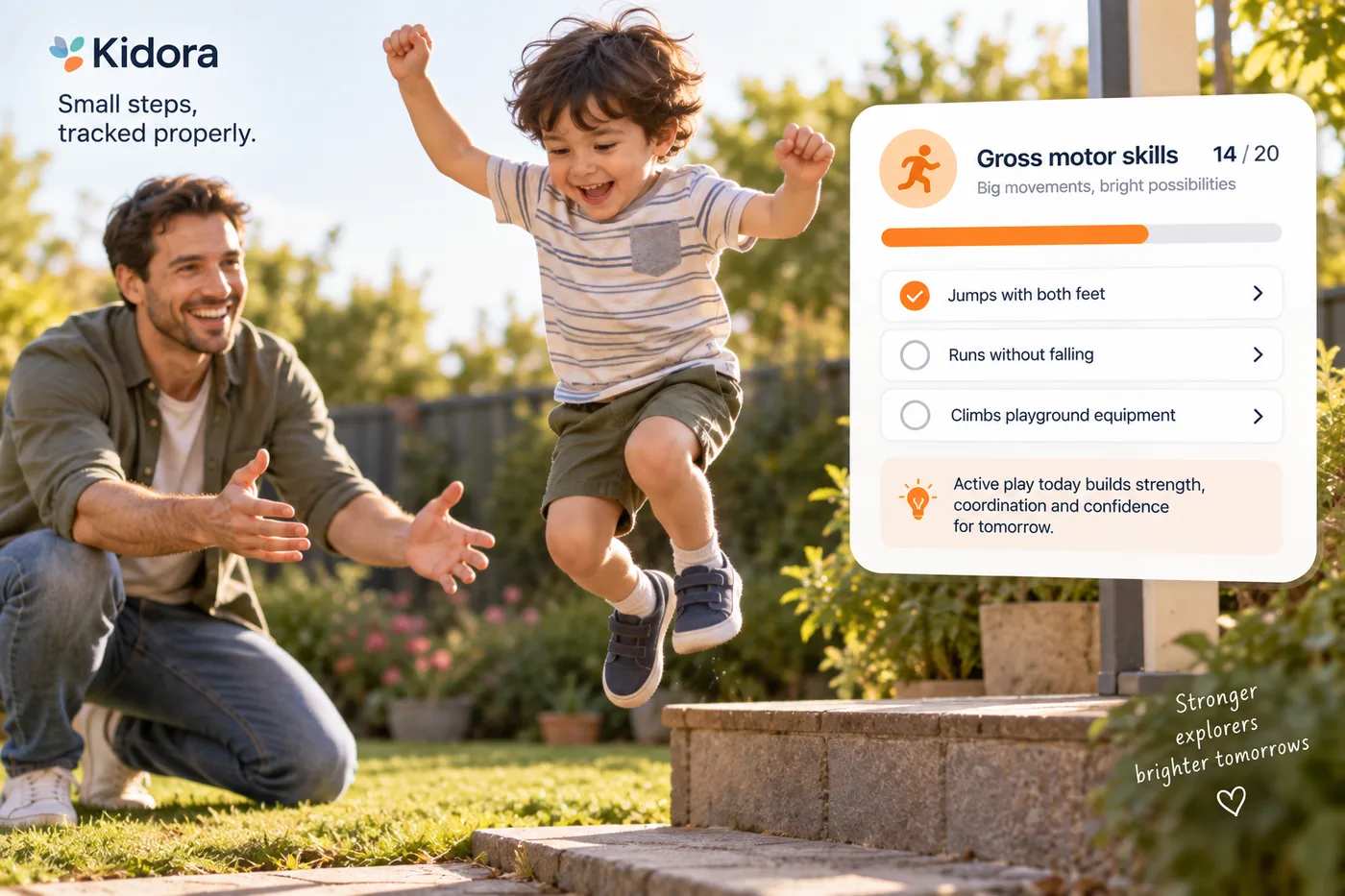
Gross motor skills are the large-muscle movements that move the whole body: rolling, sitting, crawling, walking, running, jumping and climbing. They develop from head to toe, starting with head control in the first weeks and reaching skipping and ball skills by about six.
Ask any parent when their child walked and you'll get a month and probably a week. Ask when they first balanced on one foot and you'll get a blank look.
Both are gross motor milestones. One got a video sent to the whole family. The other passed unnoticed, which is a shame, because balance and coordination are where the later problems actually live.
What are gross motor skills?
Gross motor skills use the large muscles of the legs, arms and trunk to move the body through space. They cover posture, balance and coordination as well as obvious skills like walking, and they form the stable base that precise hand movements depend on.
The category is broader than it sounds. It includes:
- Postural control, which is holding the head and trunk steady against gravity. Everything else is built on this.
- Locomotion, moving from place to place. Rolling, crawling, walking, running.
- Balance, both standing still and while moving.
- Coordination, using both sides of the body together, like catching a ball or pedalling.
Here's the part that surprises parents: gross motor skills are the foundation for fine motor skills. A child needs a stable trunk and shoulders before the fingers can do precise work. Handwriting problems often start in the core, not the hand.
How do gross motor skills develop?
Gross motor development follows two directions. It runs head to toe, so head control comes before sitting and sitting before walking. And it runs from the centre of the body outward, so trunk and shoulder control develop before elbow, wrist and finger control.
The order is more reliable than the timing. Nearly every child sits before they walk. But the gap between two children reaching the same point can be six months, and both are typical.
Skipping a stage is also common and mostly harmless. Some children never crawl. They bottom-shuffle, or go from sitting to cruising to walking. The claim that skipping crawling causes reading problems later is popular and has no good evidence behind it.
What gross motor milestones should you expect at each age?
Most babies hold their head steady by 4 months, sit unsupported by 8 months and walk between 9 and 18 months. By 2 most run and kick a ball. By 3 most pedal a tricycle and jump with both feet. By 5 most hop, skip and catch a bounced ball.
| Age | What the body is doing |
|---|---|
| 0 to 6 months |
|
| 6 to 12 months |
|
| 1 to 2 years |
|
| 2 to 3 years |
|
| 3 to 4 years |
|
| 4 to 6 years |
|
Uneven ground teaches balance faster than flat ground. A grassy slope, a low wall, a pile of cushions or a woodland path makes the body constantly correct itself. Twenty minutes on rough terrain beats an hour on a smooth playground floor.
Check your child's gross motor skills free
About eight minutes, and it covers all six areas rather than movement alone.
Start the free checkWhat are the signs of a gross motor delay?
Signs of gross motor delay include not sitting by 9 months, not walking by 18 months, a body that feels stiff or floppy, using only one side of the body, frequent falling after three years, and avoiding climbing or running that other children enjoy.
- A skill has gone backwards. A child who walked and has stopped needs to be seen now. This outranks everything else here.
- Not sitting unsupported by 9 months, or not walking by 18 months.
- Stiff or floppy to handle, or legs that cross and scissor when held upright.
- Using one side much more than the other, or a clear hand preference before 18 months.
- Constant tiptoe walking past two years.
- Avoiding physical play that same-age children throw themselves into. This is often the earliest and quietest sign.
Who to speak to
Gross motor concerns usually route to a physiotherapist through your paediatrician. Bring a video on your phone if you can. Two minutes of your child walking or climbing tells a physio more than ten minutes of description, and children rarely perform on cue in a clinic room.
How can you build gross motor skills at home?
Gross motor skills grow through unstructured active play rather than lessons. Floor space, uneven ground, climbing opportunities, barefoot walking and things to push and pull build strength, balance and coordination more effectively than any structured programme.
What actually helps, in order:
- Space and time. A safe floor and an unhurried hour outperform equipment.
- Uneven surfaces. Grass, sand, slopes, cushions. Balance is trained by instability.
- Barefoot where safe. Feet feed the balance system information that thick soles block.
- Climbing. Pulling the body upward builds core and shoulder strength, which is what fine motor work later depends on.
Tummy time from day one
Short sessions several times a day, on a firm floor. Lie down facing him so there's a reason to lift the head. Everything from rolling to crawling is built here.
Cushion mountain
Pile sofa cushions on the floor and let her climb over them. Unstable surfaces make the whole body work, and toddlers will repeat this for as long as you allow it.
Walk the tape line
A strip of masking tape on the floor, walked heel to toe with arms out. Add a curve or a zigzag once the straight line is easy. Pure balance training that costs nothing.
Push something heavy
A laundry basket with books in it, pushed across the room. Pushing and pulling against resistance builds core strength, and it feels like helping rather than exercise.
Get gross motor activities matched to your child →
Questions parents ask
Common questions about gross motor skills
What are examples of gross motor skills?
Rolling over, sitting up, crawling, walking, running, jumping, climbing stairs, kicking a ball, hopping and riding a bike. Anything using the large muscles to move the whole body.
What is the difference between fine and gross motor skills?
Gross motor skills use the large muscles for whole-body movement. Fine motor skills use the small muscles of the hands and fingers for precise tasks. Gross motor control develops first and provides the stable base fine motor work needs.
At what age should a baby sit up?
Most babies sit without support between 6 and 8 months. Speak to your doctor if your baby is not sitting unsupported by 9 months.
Is it bad if my child never crawled?
No. Bottom-shuffling and going straight to walking are both common variations. The claim that skipping crawling causes later learning problems is not supported by good evidence.
Why does my child fall over so much?
New walkers fall constantly and that is expected. Frequent falling after three years, or a child who trips far more than peers, is worth mentioning to your doctor, since balance and coordination difficulties respond well to physiotherapy.
Do baby walkers help with gross motor development?
No. They hold a child upright before their balance is ready, reduce the floor time that builds real walking, and carry a genuine injury risk. Floor space is the better option.
Related
Written and reviewed by Ms. Tehreem Talat, Consultant Clinical Psychologist. Last reviewed 9 September 2026. Milestones drawn from the Portage checklist and CDC guidance. See our sources. This page is a guide for parents, not a medical diagnosis.