Home › Social and emotional development
Social and emotional development in children
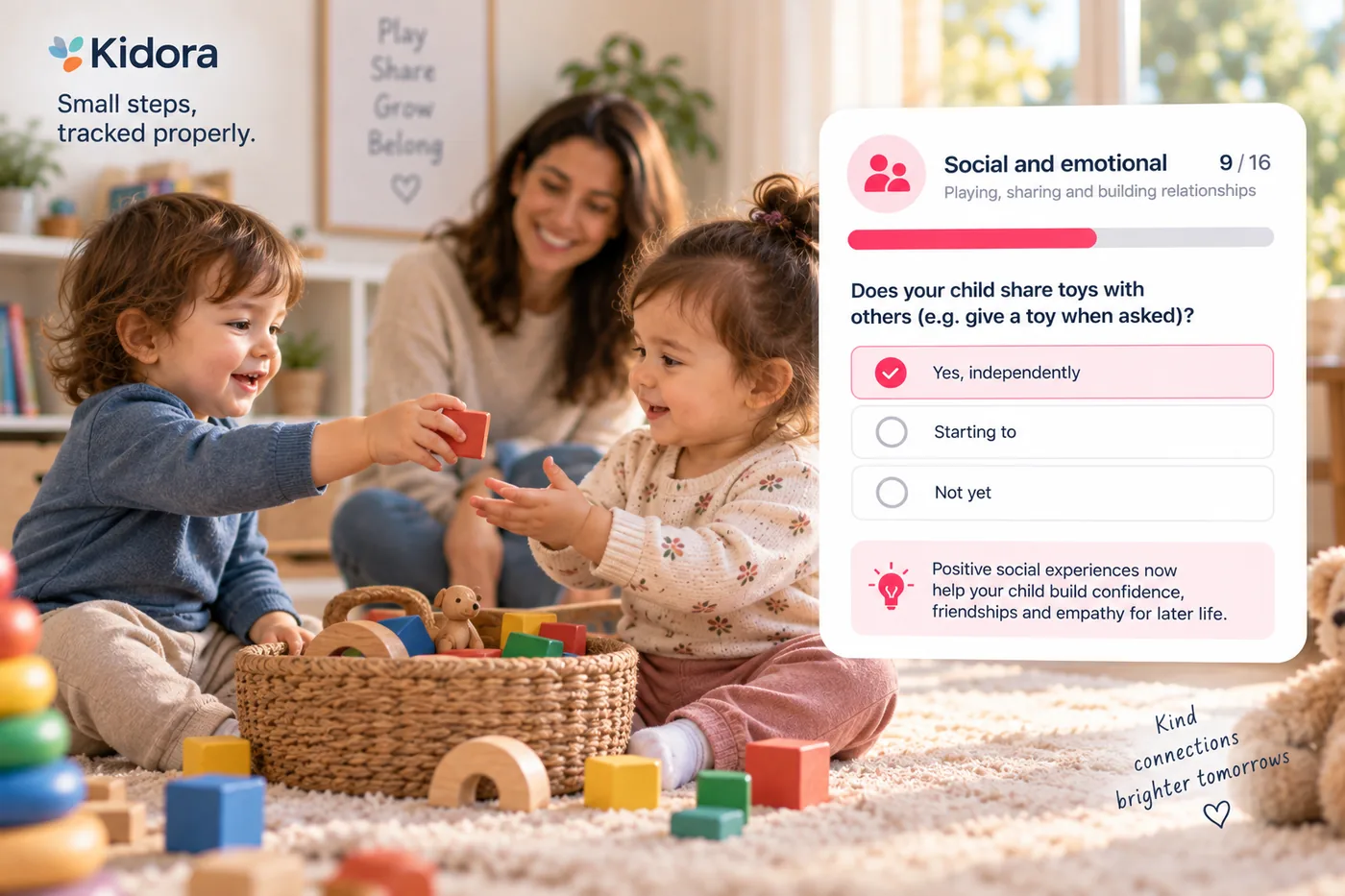
Social and emotional development is how a child learns to connect with people and handle feelings. It runs from a first smile to sharing, taking turns and understanding that someone else can want something different. It develops through relationships, not through teaching.
This is the area parents judge themselves on. A late walker is just a late walker. A three-year-old who snatches a toy at a birthday party feels like a verdict on the parenting.
It isn't. Most of what looks like bad behaviour in the first four years is a skill that hasn't arrived yet, and knowing the order those skills arrive in changes what you do about it.
What is social and emotional development?
Social and emotional development is the growing ability to form relationships, understand feelings and manage behaviour. It covers attachment to caregivers, playing with other children, recognising emotions, and gradually learning to wait, share and recover from being upset.
It has four strands, and they mature at very different speeds:
- Attachment. The bond with a small number of familiar adults. This forms first and everything else is built on it.
- Social interaction. Smiling back, watching other children, then playing near them, then playing with them.
- Emotional understanding. Recognising feelings in themselves, then in other people.
- Self-regulation. Managing frustration and recovering from upset. This one is still developing well into the school years and beyond.
Self-regulation is the slowest of the four by a distance, which is worth holding onto. The part of the brain that manages impulse control is nowhere near finished at four. A tantrum in a two-year-old is not a discipline failure, it is an unfinished skill.
This area also depends heavily on the others. Children build social skills through language, so a child who cannot yet explain what they want will grab instead. And joining in a game needs the physical confidence that gross motor development provides. A child hanging back at the playground may be socially cautious, or may simply not trust their own climbing.
How does social development actually progress?
Play develops in a fixed order: solitary play, then watching others, then playing alongside without interacting, then cooperative play with shared rules. Parallel play, where two children play side by side without joining in, is the normal stage for most two-year-olds.
Parents worry when a toddler at a playgroup ignores every other child and plays alone next to them. That's the expected stage, not a problem, and knowing the sequence saves a lot of unnecessary alarm.
| Stage of play | Typical age | What it looks like |
|---|---|---|
| Solitary | 0 to 2 years | Plays alone, absorbed in their own activity |
| Onlooker | Around 2 years | Watches other children closely without joining in |
| Parallel | 2 to 3 years | Plays beside another child, same activity, no interaction |
| Associative | 3 to 4 years | Talks and shares materials, but no shared goal yet |
| Cooperative | 4 years and up | Plays a game together with roles and agreed rules |
What social and emotional milestones should you expect at each age?
Most babies smile socially by 2 months and show stranger wariness by 9 months. By 2 years most copy adults and play alongside other children. By 3 most take turns with help. By 5 most play cooperative games and can name how another child is feeling.
| Age | With people | With feelings |
|---|---|---|
| 0 to 6 months |
|
|
| 6 to 12 months |
|
|
| 1 to 2 years |
|
|
| 2 to 3 years |
|
|
| 3 to 4 years |
|
|
| 4 to 6 years |
|
|
Kidora's check contains 83 social checkpoints and asks only the ones matched to your child's age band.
Name the feeling before you deal with the behaviour. "You're angry because he took the car" gives a child the word for what's happening inside them. Children who can name feelings manage them sooner, and the naming has to come from you first.
Check your child's social and emotional skills free
About eight minutes, and it shows how this area compares against the other five.
Start the free checkWhy won't my child share?
Sharing on request is not typical until around three years, and reliable sharing comes later still. A two-year-old who refuses to hand over a toy is at the expected stage. Sharing needs an understanding of ownership and of another person's wants, and both arrive after two.
Three things have to be in place before a child can share, and none of them are present at eighteen months.
- Understanding that the toy is theirs and stays theirs. Without ownership, handing something over feels like losing it permanently.
- Understanding that another child wants it. This is perspective-taking, and it emerges gradually from about three.
- Enough impulse control to wait. The slowest of the three.
Turn-taking works long before sharing does. "Two more minutes, then it's her turn" gives a child a structure they can actually manage, where "share nicely" asks for a skill they don't have yet.
And forced sharing teaches the wrong thing. A child made to hand over a toy on demand learns that possessions are unpredictable, which tends to make them grip harder next time.
When should you speak to someone?
Speak to your doctor if your child does not smile socially by 3 months, does not respond to their name by 12 months, does not point to show you things by 15 months, shows no interest in other children by 3 years, or loses social skills they previously had.
- A skill has gone backwards. A child who made eye contact, waved or babbled socially and has stopped should be seen. This outranks everything else here.
- No social smile by 3 months.
- Little eye contact, or not looking to your face to check how to react.
- No pointing to show you something by 15 months. Pointing to share attention is one of the most informative early social skills there is.
- No interest in other children by 3 years, when most are at least watching.
- No pretend play by 3 years.
- Your instinct says something is wrong. Parents are usually right.
Who to speak to
Start with your paediatrician, who can refer on to a clinical psychologist or a developmental assessment service. Bring examples rather than labels: what your child does at a playgroup, how they react when you leave the room, whether they bring you things to show you. Specific observations are far more useful than a description of your worry.
Being shy is not the same as struggling socially. A cautious child who watches for twenty minutes and then joins in is doing fine. The pattern worth attention is a child who shows no interest in other people at all.
How can you support social and emotional development at home?
Social and emotional skills grow through relationships rather than lessons. Responding consistently, naming feelings out loud, playing pretend, and letting a child recover from small frustrations with you nearby all build this area more than any structured activity.
Play face to face
Peekaboo, copying his sounds back, pulling faces and waiting for a reaction. The back-and-forth is the whole point, and it's the earliest form of a conversation.
Feed the doll, put the bear to bed
Pretend play is how children rehearse other people's points of view. Follow her lead rather than directing the story, even when the story makes no sense.
Turn-taking with a timer
A sand timer makes waiting visible, which is far easier than waiting in the abstract. Start with one minute. This teaches the skill that actually precedes sharing.
A note on this section: only 6 of our 83 social checkpoints currently have a matched activity in the library, so this list is shorter than on our other pages. We would rather show three sourced activities than pad the page with fifteen we cannot stand behind.
Questions parents ask
Common questions about social and emotional development
At what age do children start to share?
Sharing on request appears around three years, and reliable sharing later than that. Before three, turn-taking with adult support is the realistic goal.
Is parallel play normal?
Yes. Playing alongside another child without interacting is the expected stage for most two-year-olds, and it is a step toward cooperative play rather than a sign of avoiding it.
Why does my toddler have so many tantrums?
Because the ability to manage strong feelings develops much more slowly than the feelings themselves. Tantrums usually peak between eighteen months and three years and ease as language improves, since a child who can say what they want has less need to explode.
Is my child just shy, or is something wrong?
Shyness means hanging back and then joining in. The pattern worth checking is no interest in other people at all, no eye contact, or not bringing you things to show you.
What are signs of a social and emotional delay?
No social smile by three months, no response to their name by twelve months, no pointing to show you things by fifteen months, no pretend play by three years, or any social skill that has been lost.
Does daycare help social development?
It gives children more practice with peers, which helps. It is not a requirement. Children raised at home with regular contact with other children develop the same skills on the same timetable.
Related
Written and reviewed by Ms. Tehreem Talat, Consultant Clinical Psychologist. Last reviewed 9 September 2026. Milestones drawn from the Portage checklist and CDC guidance. See our sources. This page is a guide for parents, not a medical diagnosis.