Home › Milestones › When should a baby roll over?
When should a baby roll over?
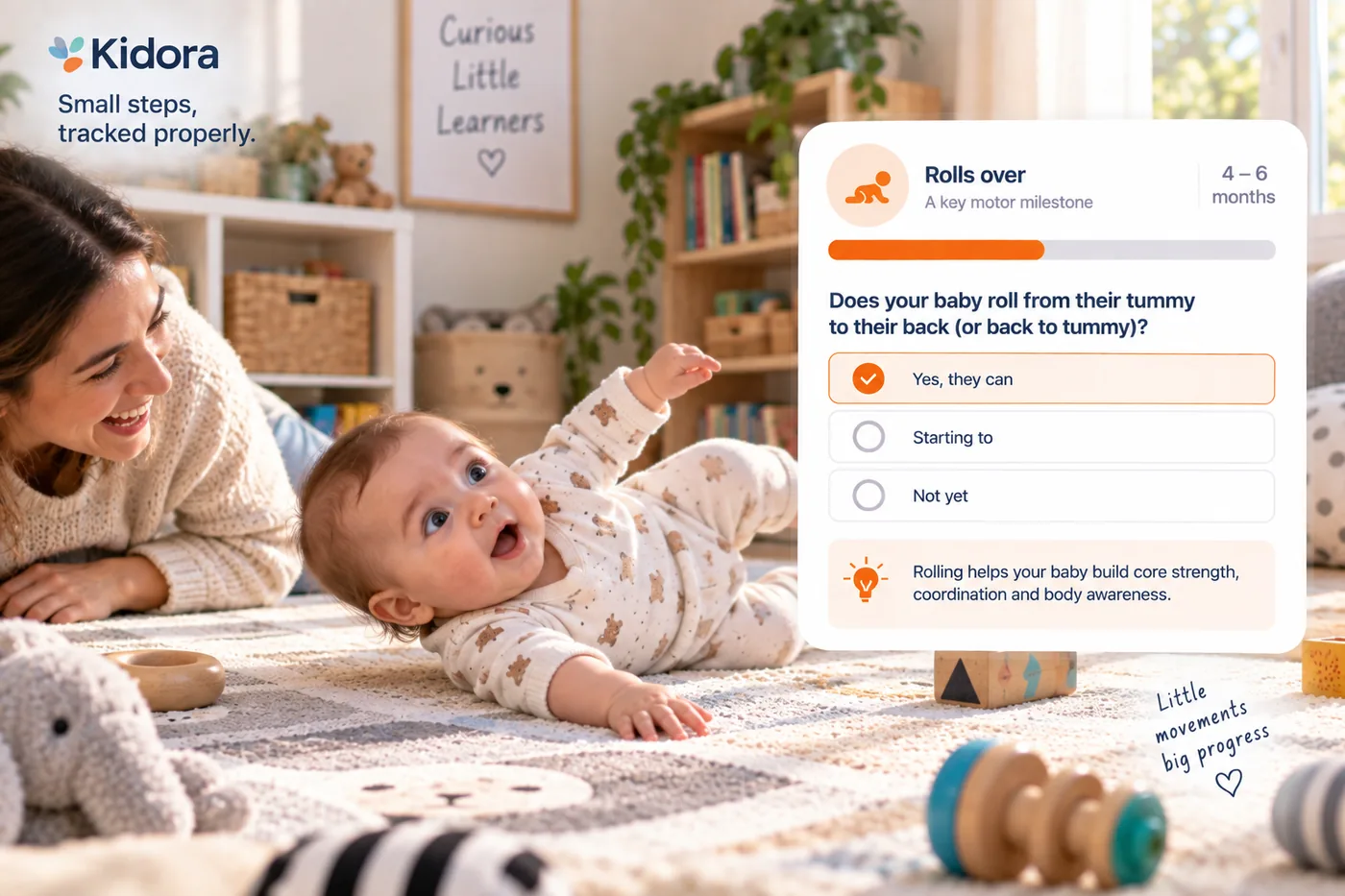
Most babies roll from tummy to back between 4 and 6 months, and from back to tummy between 5 and 7 months. Tummy to back usually comes first because it needs less strength. Speak to your doctor if your baby is not rolling at all by 7 months.
Rolling is the first time a baby moves themselves somewhere on purpose. Up to that point the world came to them. Now they can change their own view, and most of them look astonished the first time it happens.
At what age do babies roll over?
Tummy to back rolling typically appears between 4 and 6 months, and back to tummy between 5 and 7 months. Some babies roll as early as 3 months, usually by accident, and others take until 7 months. Both ends of that range are normal.
| Stage | Typical age | What you see |
|---|---|---|
| Pushing up | 2 to 4 months | Lifts head and chest during tummy time, propped on forearms |
| Rocking | 3 to 5 months | Rolls onto one side and back again, kicking one leg across |
| Tummy to back | 4 to 6 months | Tips over, often accidentally at first, then on purpose |
| Back to tummy | 5 to 7 months | Harder, needs more strength and coordination |
| Rolling to travel | 6 to 8 months | Rolls repeatedly to cross the room and reach things |
Tummy to back comes first for a simple mechanical reason: the arms are already underneath and pushing, so a shift of weight tips them over. Going the other way means lifting the body against gravity with nothing to push against.
What changes once your baby can roll?
Once a baby can roll both ways, safe sleep guidance changes. Keep placing them on their back to sleep, but there is no need to turn them back over if they roll during the night. Stop swaddling as soon as any rolling starts, since a swaddled baby cannot push themselves back.
This is the practical part of the milestone and the bit that catches parents out.
- Stop swaddling at the first sign of rolling. Arms need to be free. A sleep bag with armholes is the usual replacement.
- Keep putting them down on their back, every time, even once they roll.
- Leave them if they roll in their sleep. A baby who can roll both ways can manage their own position.
- Never leave them on a raised surface. Changing tables and beds become a genuine hazard the week rolling starts, and it usually starts without warning.
Put a favourite toy just out of reach and slightly to one side during tummy time. Reaching across the body is what starts a roll, so the toy does the teaching. Directly in front of them does nothing.
Check every milestone for your baby's age
Free, about eight minutes, covering all six areas of development.
Start the free checkHow can you help your baby learn to roll?
Tummy time is the main thing that helps. Short sessions several times a day build the neck, shoulder and trunk strength rolling needs. Floor time on a firm surface matters more than any equipment, and time in seats and bouncers works against it.
- Tummy time from birth, a few minutes at a time, several times a day.
- Firm surface, not a soft bed. A soft mattress absorbs the push.
- Get down at their level so there is a reason to lift the head and turn.
- Limit time in car seats and bouncers. Every hour in a seat is an hour not spent building the muscles this needs.
- Side lying with a rolled towel behind the back makes the last part of the roll easier and lets them feel the movement.
When should you speak to a doctor?
Speak to your doctor if your baby is not rolling in either direction by 7 months, rolls only ever to one side, feels stiff or floppy to handle, or has stopped rolling after previously doing it.
- A skill has gone backwards. This outranks everything else here.
- No rolling in either direction by 7 months.
- Always rolls to the same side, or uses one arm much more than the other.
- Stiff or floppy to handle.
- Head always turned to the same side, which can point to tightness in the neck that is easily treated when caught early.
Corrected age for premature babies
Count from the original due date, not the birth date, until around two years. A baby born eight weeks early who rolls at seven months is rolling at five months corrected, which sits comfortably in the typical range.
What comes after rolling?
Rolling builds the trunk strength that sitting needs, so sitting without support usually follows within a couple of months. After that comes crawling or shuffling, then pulling to stand, then walking.
Not every baby does these in the textbook order, and skipping one is common.
Questions parents ask
Common questions about rolling over
Which way do babies roll first?
Tummy to back, usually, because the arms are already pushing underneath. Back to tummy needs more strength and tends to follow a month or two later.
Is it normal for a baby not to roll at 6 months?
Yes, if they are making progress in other ways such as pushing up strongly during tummy time. Speak to your doctor if there is no rolling in either direction by 7 months.
Should I stop swaddling when my baby rolls?
Yes, at the first sign of rolling. A swaddled baby who rolls onto their tummy cannot push themselves back up. Move to a sleep bag with armholes.
What if my baby rolls onto their tummy in their sleep?
Keep placing them on their back at the start of the night, but there is no need to turn them back if they roll themselves. A baby who can roll both ways can manage their own position.
Can some babies skip rolling?
Some babies do very little rolling and move straight on to sitting and shuffling. What matters is that they are moving and progressing, not that every stage appears in order.
Related
Written and reviewed by Ms. Tehreem Talat, Consultant Clinical Psychologist. Last reviewed 9 September 2026. Milestones drawn from the Portage checklist and CDC guidance. See our sources. This page is a guide for parents, not a medical diagnosis.