Home › Sensory development
Sensory development and infant stimulation
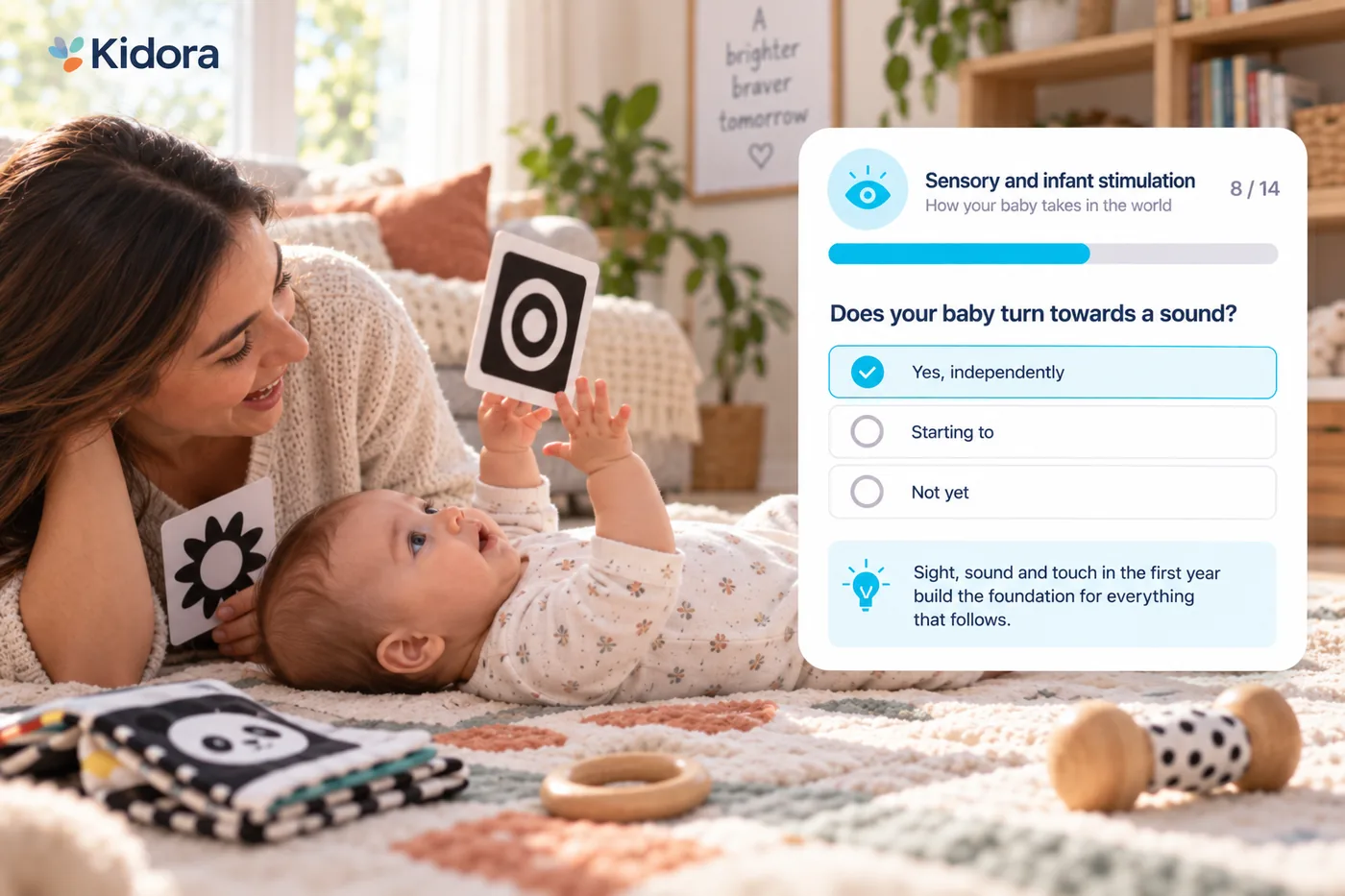
Sensory development is how a baby learns to take in and make sense of sight, sound, touch, movement and taste. It happens mostly in the first year, and it is the foundation the other five areas are built on. A baby has to notice the world before they can act on it.
This is the area nobody thinks to check, because the skills involved don't look like skills. A baby turning her head toward a voice isn't doing anything a parent would film.
But it's the first thing that happens, and everything else waits on it. A baby who can't hear you clearly won't learn words on schedule. One who can't track a moving object won't reach for it. Sensory development sits underneath all five of the other areas.
What is sensory development and infant stimulation?
Sensory development is the growing ability to receive and interpret information through the senses. Infant stimulation means giving a baby the right amount of sensory experience to support that: things to look at, sounds to turn toward, and textures to feel.
Babies work with more than the familiar five. Two extra ones matter a great deal in the first year:
- Sight. Newborn vision is blurry beyond about 30cm. High contrast is easier to see than colour, which is why black and white cards hold a young baby's attention.
- Hearing. Working before birth. Babies prefer familiar voices from day one.
- Touch. The most developed sense at birth, and the main channel for comfort and security.
- Taste and smell. A newborn recognises their mother's scent within days.
- The balance sense, in the inner ear, which tells a baby where their head is in space. Rocking and gentle movement feed it.
- Body awareness, the sense of where the limbs are without looking. Built through pushing, pulling and being held.
Kidora's checklist holds 45 infant stimulation checkpoints, all within the first year. It is the smallest of the six areas by count, and the only one that closes rather than continuing to six years.
Why does the first year matter so much?
The brain builds its sensory pathways fastest in the first year, shaped by what a baby actually sees, hears and touches. Ordinary daily interaction supplies almost all of it. What matters most is that difficulties with hearing or vision are found early, while those pathways are still forming.
Here's the thing though. This is also the area with the most nonsense attached to it, because it's the easiest place to sell something to an anxious new parent.
Baby brain-training programmes, flashcard schemes and educational videos for infants have no good evidence behind them. A baby needs a responsive adult, a floor, a few objects and daylight. That is genuinely the list. Talking to your baby while you change her nappy does more than any product marketed for the purpose.
The one thing worth spending effort on is early detection. Hearing loss and vision problems caught in the first year have far better outcomes than the same problems found at three, and the difference shows up later in language development.
What sensory milestones should you expect in the first year?
Most newborns turn toward a voice and focus on a face 30cm away. By 3 months most follow a moving object and calm to a familiar sound. By 6 months most turn toward a sound and reach for what they see. By 12 months most respond to their own name and explore textures by hand.
| Age | Seeing and hearing | Touch and movement |
|---|---|---|
| 0 to 3 months |
|
|
| 3 to 6 months |
|
|
| 6 to 9 months |
|
|
| 9 to 12 months |
|
|
Change your baby's view three times a day. Cot, floor mat, upright on your shoulder. A baby who spends most of the day in one position looking at one ceiling gets far less to work with, and moving them costs nothing.
Check your baby's development free
About eight minutes, covering all six areas including sensory.
Start the free checkWhat is the difference between sensory development and sensory processing?
Sensory development is the normal building of the senses in every baby. Sensory processing describes how the brain organises that information, and some children find it harder than others, reacting strongly to textures, sounds or labels. The two are related but not the same thing.
These terms get mixed up constantly online, usually by sites selling something. The distinction is simple.
| Sensory development | Sensory processing difficulty | |
|---|---|---|
| What it is | The normal building of the senses in the first year | Difficulty organising sensory information, at any age |
| Who it applies to | Every baby | Some children |
| What you notice | A baby turning toward sounds, reaching for what they see | Strong reactions to textures, clothing labels, noise or food |
| What helps | Ordinary varied daily experience | Assessment by an occupational therapist |
A toddler who screams at the seam in a sock is not showing a sensory development problem. Their senses developed fine. How the brain handles the input is the question, and that needs a proper assessment rather than a checklist.
How can you stimulate your baby's senses at home?
Talk to your baby, change their position and view through the day, offer varied safe textures, and let them mouth objects. Responsive interaction with a familiar adult supplies almost everything a baby's senses need. No product outperforms it.
High contrast, close up
Hold a bold black and white pattern about 30cm from her face and move it slowly side to side. That is the distance a newborn can focus at, and roughly the distance to your face while feeding.
Narrate everything
Talk through nappy changes, dressing and cooking. Pause as though he is replying. Your voice is the sound a baby is most interested in, and this is where language starts.
A basket of safe textures
A wooden spoon, a silicone cup, a crinkly cloth, a soft brush. Household objects beat toys here, since they vary more. Everything goes in the mouth, so check sizes and supervise.
Move them around
Gentle rocking, being carried upright, tummy time, lying on her side. Each position feeds the balance sense and gives her a different view of the room.
What to skip: screens. Health guidance is consistent that babies under eighteen months get nothing useful from them beyond video calls with family, and screen time displaces the back-and-forth with a person that actually builds the senses.
When should you speak to someone?
Speak to your doctor if your baby does not startle at loud sounds, does not turn toward a voice by 4 months, does not follow a moving object by 3 months, has eyes that turn in or out consistently after 4 months, or stops responding to sounds they previously noticed.
- A response has been lost. A baby who turned toward sounds and no longer does needs to be seen now.
- No startle to loud noise, at any age.
- Not turning toward a voice by 4 months.
- Not following a moving object by 3 months, or eyes that consistently turn in or out after 4 months.
- No interest in faces, or very little eye contact.
- Extreme distress at ordinary touch, sound or textures that disrupts daily routines.
- Your instinct says something is wrong. Parents are usually right.
Ask for hearing and vision checks first
Both are quick, painless and widely available, and both rule out the most treatable causes. A newborn hearing screen is not a permanent all-clear, since some hearing loss develops later and glue ear after ear infections is common. If you have a doubt, ask again rather than relying on the newborn result.
Questions parents ask
Common questions about sensory development
What is infant stimulation?
Giving a baby the sensory experience their brain needs to develop: things to look at, sounds to turn toward, textures to feel and movement to sense. Ordinary responsive care supplies nearly all of it.
Do babies need black and white cards?
They help, because high contrast is easier for a newborn to see than colour. They are not essential. Your face at about 30cm does the same job and holds far more interest.
When can babies see colour?
Colour vision develops over the first few months and is working well by around five months. Newborns see high contrast and edges best, which is why bold patterns hold their attention.
Can you overstimulate a baby?
Yes. Turning away, arching the back, fussing or suddenly falling asleep are signs a baby has had enough. Stopping and offering quiet is the right response, and it is as important as the stimulation itself.
Is sensory development the same as sensory processing disorder?
No. Sensory development is the normal building of the senses in every baby. Sensory processing difficulty describes how the brain organises that information, affects some children, and needs an occupational therapy assessment.
Are baby brain-training programmes worth it?
No. There is no good evidence that infant flashcard schemes or educational videos improve development. A responsive adult, floor space and a few varied objects do the work, and they cost nothing.
Related
Written and reviewed by Ms. Tehreem Talat, Consultant Clinical Psychologist. Last reviewed 9 September 2026. Milestones drawn from the Portage checklist and CDC guidance. See our sources. This page is a guide for parents, not a medical diagnosis.