Home › Self-help skills
Self-help skills in children
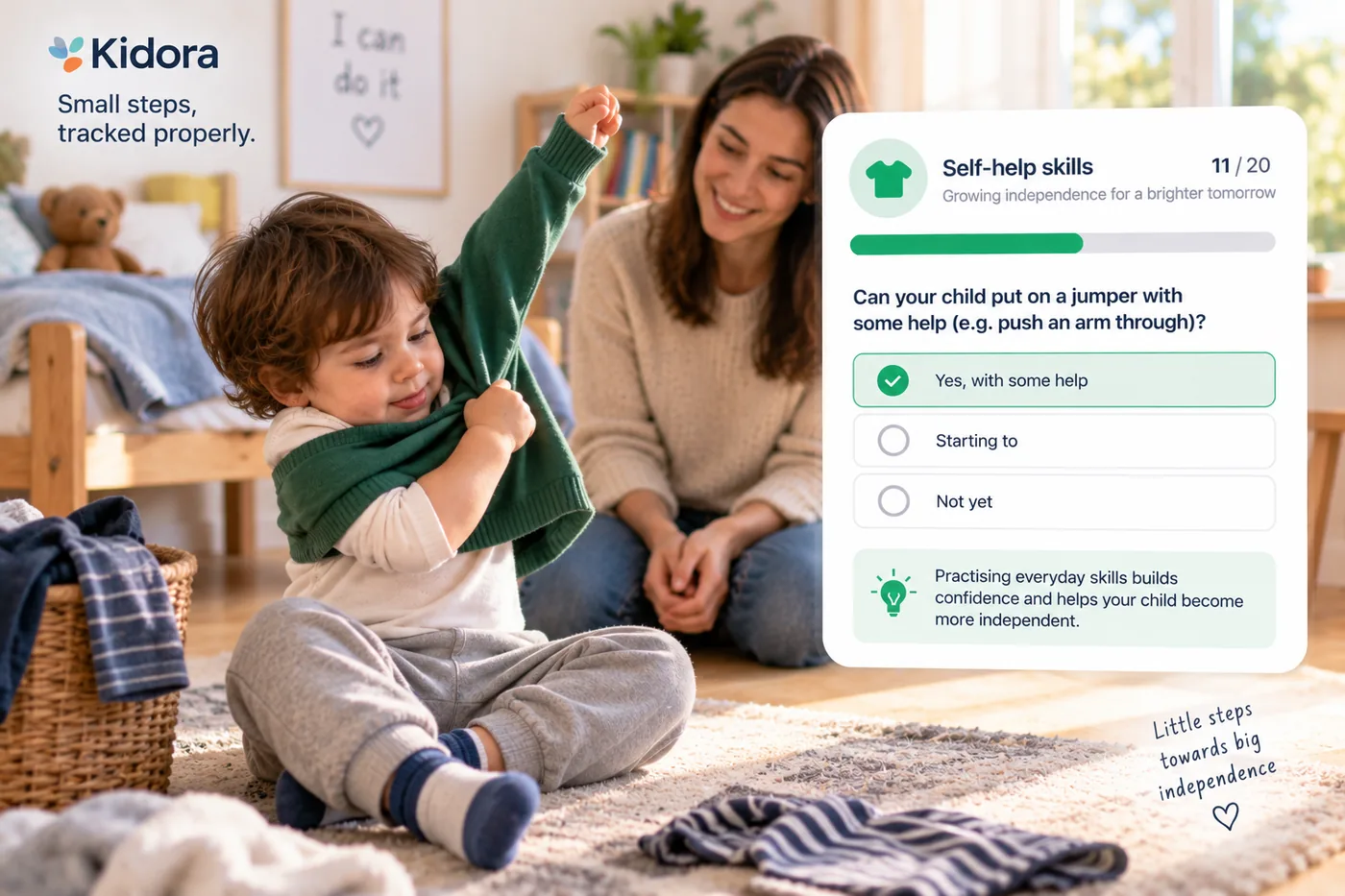
Self-help skills are the everyday things a child learns to do without help: feeding, dressing, washing, brushing teeth and using the toilet. They are the most practical area of child development and the one that most directly shapes a child's confidence.
Here's a test. Your four-year-old is putting on shoes and you're already late. Do you wait, or do you do it for them?
Everyone does it for them. That's fine once. The problem is that it's rarely once, and self-help skills are the one area of development that adults can quietly prevent from happening.
What are self-help skills?
Self-help skills, also called adaptive or daily living skills, are the routines a child performs independently: eating with cutlery, dressing, washing hands, brushing teeth, toileting and tidying up. They combine physical ability, memory for sequence, and the confidence to try.
They cover five everyday areas:
- Feeding. Holding a cup, using a spoon then a fork, pouring, serving themselves.
- Dressing. Pulling off a sock, pushing an arm through a sleeve, buttons, zips, shoes.
- Hygiene. Washing and drying hands, brushing teeth, blowing a nose.
- Toileting. Recognising the need, then managing the whole sequence.
- Helping and tidying. Putting toys away, carrying a plate to the sink.
Every one of these depends on other areas. Buttons need fine motor control. Remembering the order of getting dressed is cognition. Wanting to do it alone is emotional development. Self-help is where the other five areas show up as something visible in daily life, which makes it the most honest measure of the lot.
Kidora's checklist holds 105 self-help checkpoints, more than Language. It is the second-largest area after motor skills.
Why do self-help skills matter more than parents think?
Self-help skills predict school readiness and build genuine confidence. A child who can manage their own coat, lunch and toilet needs starts school able to focus on learning, rather than on waiting for an adult to help with something everyone else can do.
The confidence is the part that gets underrated. A child who dresses themselves has evidence that they're capable, and that evidence is worth more than any amount of praise. Praise is something adults hand out. Competence is something a child owns.
There's also a practical school argument. Reception classes have one adult to many children. A child who cannot open their own lunch box or manage the toilet spends their day dependent and often embarrassed, which affects how they feel about school long before it affects what they learn there.
Build the practice into the slow parts of the week, not the rushed ones. Nobody teaches shoe buckles at 8am on a school day. Sunday afternoon has the twenty spare minutes that this actually needs.
What self-help milestones should you expect at each age?
Most babies hold a cup by 12 months and use a spoon by 18 months. By 2 most take off simple clothing. By 3 most wash their hands and manage the toilet with reminders. By 5 most dress themselves fully and brush their teeth with supervision.
| Age | Eating and drinking | Dressing and hygiene |
|---|---|---|
| 0 to 12 months |
|
|
| 1 to 2 years |
|
|
| 2 to 3 years |
|
|
| 3 to 4 years |
|
|
| 4 to 6 years |
|
|
Check your child's self-help skills free
About eight minutes, and it shows how independence compares against the other five areas.
Start the free checkHow do you teach a self-help skill?
Break the skill into steps and let the child complete the last one first. This is called backward chaining: you pull the sock almost off, they pull it the rest of the way, and they finish every attempt with a success. Then hand over one more step each time.
Backward chaining is the single most useful technique on this page, and almost no parent has heard of it. Occupational therapists use it constantly.
- Pick one skill. Not dressing. Socks.
- Do all of it except the final step. Pull the sock to the toes, let her pull it off.
- Let her finish, every time. The attempt ends in success, so she wants to do it again.
- Hand back one more step once that step is easy, working backward toward the start.
- Stop helping the moment she can do it, even when it's slower than you doing it.
Three things make this work faster. Loose clothing with big openings. Doing it at the same point in the routine each day, so the sequence becomes automatic. And sitting on your hands, which is harder than any of the rest of it.
Let them pour their own drink
A small jug, half full, standing on a tray. Pouring builds wrist control and grip strength, and unlike a threading toy it has an obvious point the child can see.
Big buttons before small ones
Practise on a coat laid flat on the floor rather than on his own body, where he cannot see what his hands are doing. Move to buttoning while wearing it once the flat version is easy.
Give them a real job
Carrying plates to the table, matching socks from the laundry, watering a plant. Real tasks with a visible result hold a child's attention far longer than practice for its own sake.
When is a child ready for toilet training?
Toilet training readiness depends on signs, not age. Most children are ready between 18 months and 3 years, when they stay dry for around two hours, can follow a simple instruction, tell you they have gone, and show interest in the toilet.
Starting before the signs are there makes the whole thing take longer. The readiness checklist matters more than the calendar or what a cousin's child managed.
- Stays dry for about two hours, which shows bladder control is developing.
- Tells you during or after, which comes before telling you beforehand.
- Can pull trousers up and down, at least partly.
- Follows a simple two-step instruction.
- Shows interest in the toilet or in other people using it.
- Dislikes being wet or dirty.
Regression during illness, a house move or a new baby is common and usually temporary. Going back to nappies for a few weeks is not a failure, and pushing through it tends to prolong the problem rather than shorten it.
When should you speak to someone?
Speak to your doctor if your child cannot feed themselves at all by 2 years, shows no interest in doing anything independently by 3, cannot manage any dressing step by 4, or has lost a self-help skill they previously had.
- A skill has gone backwards, outside of an obvious upset like a new sibling or an illness.
- No attempt to feed themselves by 2 years.
- No interest in doing anything alone by 3 years. Most children at this age insist on it, often inconveniently.
- Cannot manage any part of dressing by 4 years.
- Strong distress around textures, clothing or foods that gets in the way of daily routines.
- Self-help sits well behind the other five areas and stays there over a few months.
Who to speak to
Self-help concerns usually route to an occupational therapist through your paediatrician. This is one of the more practical referrals in early childhood: an OT will break skills down into steps, adjust the clothing and equipment, and give you a plan you can run at home.
Before assuming a skill is missing, check whether your child has ever been given the chance to do it. A four-year-old who has always been dressed by an adult isn't behind. They've never been asked.
Questions parents ask
Common questions about self-help skills
What are self-help skills in child development?
The everyday things a child learns to do independently: feeding, dressing, washing, brushing teeth, using the toilet and tidying up. They are also called adaptive or daily living skills.
At what age should a child dress themselves?
Most children take off simple clothing by two, dress with help on fastenings by three or four, and dress fully by around five. Buttons and zips usually come last.
When should I start toilet training?
When the readiness signs appear, usually between 18 months and 3 years. Staying dry for two hours, telling you they have gone, and showing interest in the toilet matter more than the child's age.
My child can do it but refuses. Is that a problem?
No, that is usually about control rather than ability. Offer a choice within the task, like which jumper or which sock first, so the child gets a say without the task itself being optional.
What is backward chaining?
Teaching a skill by doing all of it except the last step, so the child always finishes the task successfully. You then hand back one more step at a time. Occupational therapists use it constantly and it works well at home.
Are self-help skills a sign of intelligence?
No. They reflect physical ability, practice and opportunity. A child who has always been dressed by an adult will lag on dressing regardless of how bright they are.
Related
Written and reviewed by Ms. Tehreem Talat, Consultant Clinical Psychologist. Last reviewed 9 September 2026. Milestones drawn from the Portage checklist and CDC guidance. See our sources. This page is a guide for parents, not a medical diagnosis.