Home › Milestones › When do babies clap?
When do babies clap?
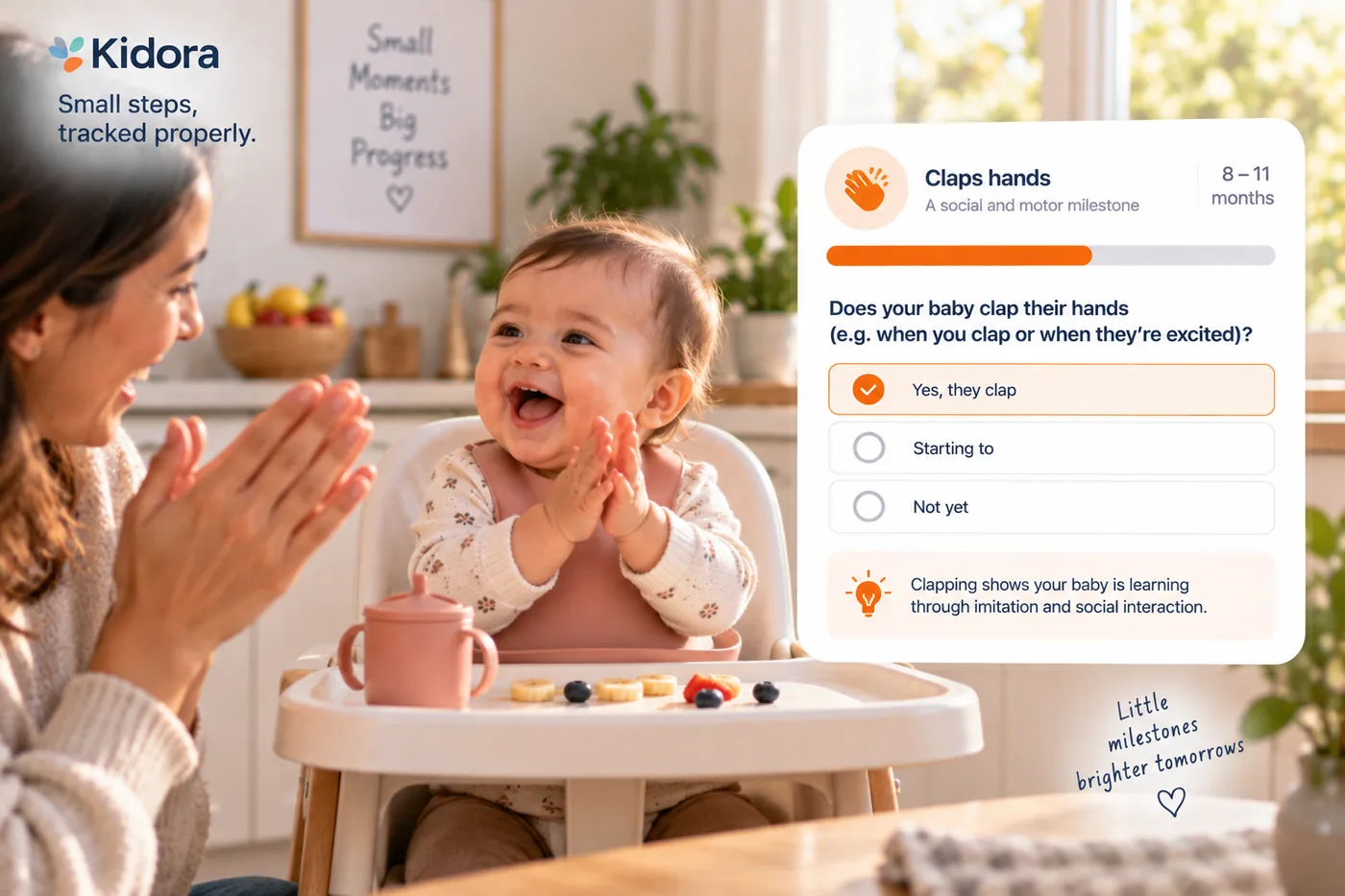
Most babies clap between 8 and 11 months. Clapping needs two skills at once: bringing both hands together at the middle of the body, and copying something an adult has done. That second part is what makes it a social milestone as much as a physical one.
Clapping looks like a party trick. It is actually the first thing many babies do at you rather than near you, and that shift matters.
At what age do babies clap their hands?
Babies typically clap between 8 and 11 months. Bringing both hands to the middle appears around 6 months, deliberate copying around 8 to 9 months, and clapping to celebrate something without being prompted by around 12 months.
| Stage | Typical age | What you see |
|---|---|---|
| Hands to the middle | 4 to 6 months | Brings both hands together in front of the chest, watches them |
| Banging two objects | 6 to 9 months | Hits two blocks together, the physical rehearsal for clapping |
| Copying a clap | 8 to 11 months | Claps back when you clap, usually with a delay at first |
| Clapping spontaneously | 10 to 14 months | Claps to celebrate, or to get a reaction from you |
Banging two blocks together is the step most parents miss. It is the same movement as a clap with objects in the way, and a baby who does it has the physical part sorted.
Why does clapping matter?
Clapping shows a baby can imitate on purpose, which is how most early learning happens. It also crosses the midline of the body, bringing both hands to the centre, and it is a shared social act performed for another person rather than alone.
Three things are happening at once:
- Imitation. Watching, remembering and reproducing an action. This is the engine behind waving, pointing and eventually words.
- Crossing the midline. Both hands meeting at the centre of the body, which matters for later fine motor skills.
- Social exchange. A clap is done for an audience. It is a turn in a conversation before there are any words in it.
That last one is why clapping sits alongside waving and pointing as an early social milestone, and why its absence is worth more attention than a late motor skill on its own.
Clap her hands gently for her, then pause and wait. Feeling the movement teaches it faster than watching you do it, and the pause is where her turn goes. Most adults fill that silence in under a second.
Check every milestone for your baby's age
Free, about eight minutes, covering all six areas of development.
Start the free checkHow can you encourage clapping?
- Clap in games and songs with a predictable rhythm, so he learns when the clap is coming.
- Give him two blocks to bang together. Same movement, easier to hold.
- Guide his hands, then let go and wait for him to try it himself.
- React every time. A big response is the whole reward, and it is what makes him do it again.
- Clap for real things. Finishing a meal, standing up, arriving home. It gives the action a meaning rather than making it a trick.
When should you speak to a doctor?
Speak to your doctor if your baby is not clapping, waving or pointing by 12 months, does not copy any of your gestures, does not respond to their name, or has stopped doing gestures they previously did.
Clapping alone is not the thing to watch. What matters is whether a baby copies gestures at all, and whether they use them to share something with you.
- A gesture has been lost. This outranks everything else here.
- No clapping, waving or pointing by 12 months.
- No copying of any kind by around 12 months.
- No response to their own name by 12 months.
- Little eye contact, or no interest in a back-and-forth game.
Gesture matters more than most parents are told
Clapping, waving and pointing arrive together and predict spoken language better than early vocabulary does. A baby with no gestures at 12 to 15 months is worth mentioning to your doctor even if everything else seems fine, and a hearing check is a sensible first step.
Questions parents ask
Common questions about clapping
Is clapping a developmental milestone?
Yes. It sits in both the motor and social areas, because it needs the physical skill of bringing both hands to the middle and the social skill of copying an adult on purpose.
My 12 month old doesn't clap. Should I worry?
Not on its own, if they wave, point or copy other things. What matters is whether they use any gestures to share something with you. No gestures at all by 12 to 15 months is worth mentioning to your doctor.
What comes first, waving or clapping?
They usually appear within a month or two of each other, between 8 and 12 months. Neither order is a concern.
How do I teach my baby to clap?
Clap in songs with a steady rhythm, guide their hands gently, then pause and wait. Feeling the movement works better than watching it, and giving them time to try is the part most adults skip.
Related
Written and reviewed by Ms. Tehreem Talat, Consultant Clinical Psychologist. Last reviewed 9 September 2026. Milestones drawn from the Portage checklist and CDC guidance. See our sources. This page is a guide for parents, not a medical diagnosis.