Home › Milestones › When do babies talk?
When do babies say their first words?
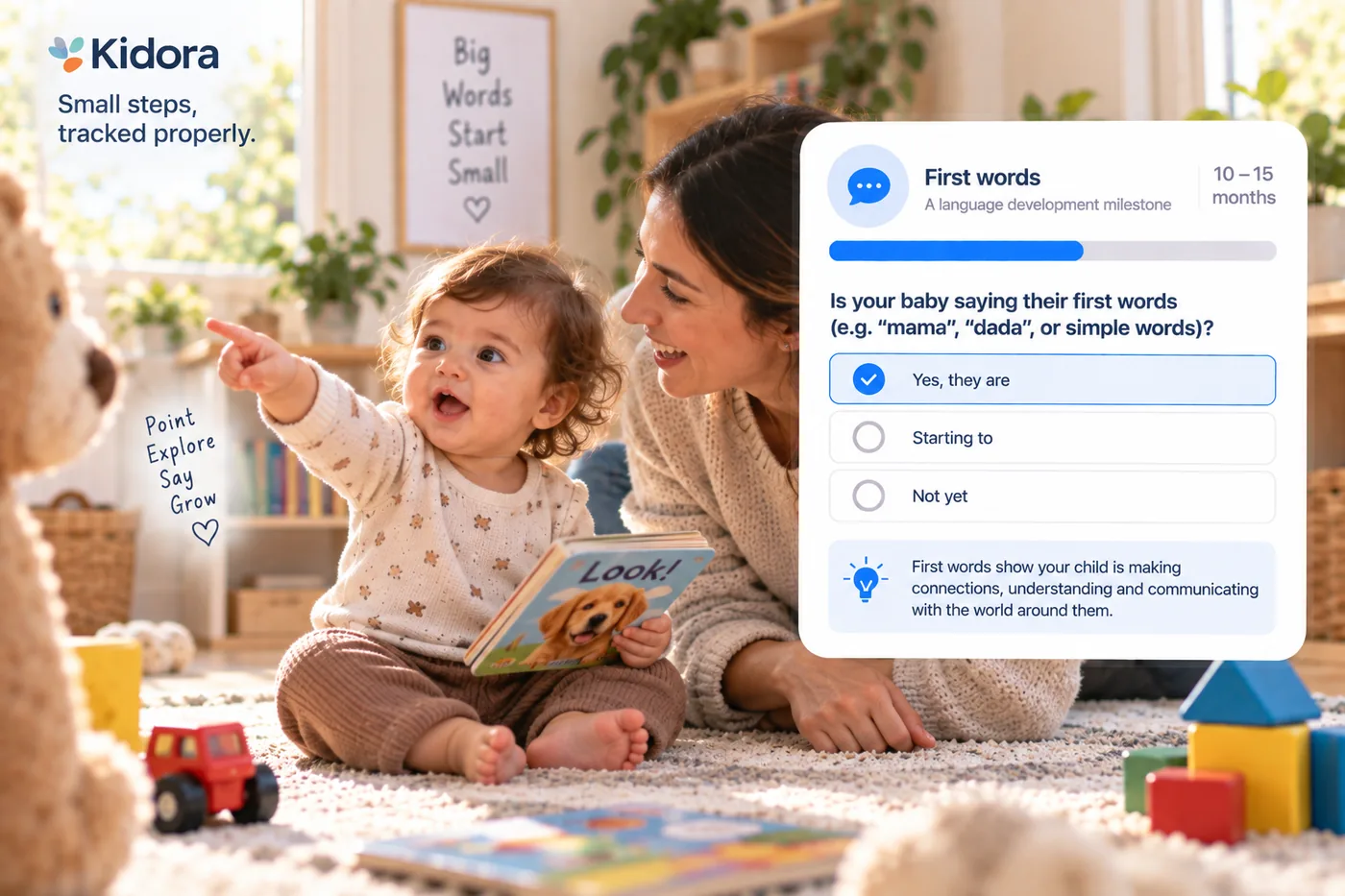
Most babies say a first word between 10 and 15 months. A word counts if it is used consistently to mean the same thing, even when it is not pronounced clearly. Speak to your doctor if your child has no words at all by 18 months.
Parents track this one obsessively, and usually track the wrong thing. Vocabulary size at 15 months tells you far less than whether your baby points at things to show you.
At what age do babies say their first word?
Babies typically babble strings of sounds by 9 months and say a first real word between 10 and 15 months. By 18 months most have several words, and by 24 months most have around 50 and are joining two together.
| Stage | Typical age | What it sounds like |
|---|---|---|
| Cooing | 2 to 4 months | Open vowel sounds in response to your face |
| Babbling | 6 to 10 months | Repeated consonants, bababa and dadada |
| Gesture | 9 to 12 months | Points, waves and claps to share attention |
| First word | 10 to 15 months | One word used consistently with meaning |
| Word spurt | 18 to 24 months | Vocabulary grows quickly, around 50 words by two |
| Two words together | 18 to 24 months | More milk, daddy gone |
What counts as a word?
A word counts if it is used consistently for the same thing, whether or not it sounds right. "Ba" for bottle every single time is a word. "Mama" said while babbling at the ceiling is not, yet.
Parents undercount badly here. Animal sounds count. Names for people count. "Uh-oh" counts. Count across every language your child hears, not just one.
Why pointing matters more than the first word
Pointing to show you something predicts spoken language better than early vocabulary does. A baby who points at a dog to share it with you is already doing the social work language is built on. Absence of pointing by 15 months carries more weight than a small vocabulary.
There are two kinds of pointing and only one of them counts for this.
- Pointing to get. Reaching toward something they want. Useful, but it is a request.
- Pointing to show. Pointing at a bird, then looking back at your face to check you saw it too. That look back is the whole thing.
That second kind is shared attention, and it is the foundation under every word that follows. Most parents have never been told to watch for it.
Say it back with one word added. He says "dog", you say "big dog" or "dog running". Adding exactly one word to what your child produced is the most evidence-backed language technique there is, and it needs no preparation at all.
Check every milestone for your baby's age
Free, about eight minutes, covering all six areas of development.
Start the free checkHow can you encourage first words?
- Wait five seconds after you ask something. Most adults wait one. Children need far longer to assemble a reply.
- Name what she is already looking at, rather than redirecting her attention to what you want to teach.
- Narrate ordinary routines. Dressing, cooking, shopping.
- Read the same book repeatedly and pause before the familiar line.
- Cut background television. It masks the speech she would otherwise hear.
When should you speak to a doctor?
Speak to your doctor if your child does not respond to their name by 12 months, is not pointing by 15 months, has no words by 18 months, is not joining two words by 2 years, or has lost words they previously used. Ask for a hearing test first in every case.
- Words have been lost. This outranks everything else here.
- No response to their name by 12 months.
- No pointing or gesture by 15 months.
- No words by 18 months.
- Not joining two words by 2 years.
Ask for the hearing test first
It is quick, painless and rules out the most common and most treatable cause. Glue ear after repeated ear infections is easy to miss, and a child who hears words as muffled cannot learn them. A newborn hearing screen is not a permanent all-clear, since some hearing loss develops later.
On bilingual households: hearing two or three languages does not cause late talking. Count words across all of them. A real difficulty shows up in every language, not just one, and dropping the home language usually makes things worse. More on this on our language development page.
Questions parents ask
Common questions about first words
What is usually a baby's first word?
Commonly mama, dada, or the name of a pet, a bottle or a favourite object. It tends to be something present many times a day with an easy sound at the start.
Does babbling count as talking?
No, but it is a necessary step. Babbling is practice with sounds. A word is a sound used consistently to mean one thing.
My 18 month old has no words. What should I do?
Book a hearing test and speak to your doctor about a speech and language referral. This is a sensible first step rather than a diagnosis, and hearing is the most common treatable cause.
Does being bilingual delay first words?
No. Bilingual children reach the milestones on the same schedule. They may have fewer words in each language while having the same total across both.
Do boys talk later than girls?
Boys sit slightly later on average, but the normal range is the same. Using it to explain away a real difficulty is how children miss the window when help works best.
Related
Written and reviewed by Ms. Tehreem Talat, Consultant Clinical Psychologist. Last reviewed 9 September 2026. Milestones drawn from the Portage checklist and CDC guidance. See our sources. This page is a guide for parents, not a medical diagnosis.